A pork shoulder is a weekend animal.
Mine goes into the oven around ten on a Saturday morning, rubbed the night before, and it does not come out until the middle of the afternoon.
Nothing about that is fast.
That is the honest framing for this recipe, and I would rather say it up front than pretend a 4 hour braise fits between work and dinner.
What you get for the wait is about 8 cups of pork that pulls apart under a fork.
Four sweet potatoes use maybe half of it.
The other half is the real reason I cook a shoulder at all, because it feeds us again on Monday and again on Wednesday in completely different clothes.
So this is a Sunday dish built on a Saturday.
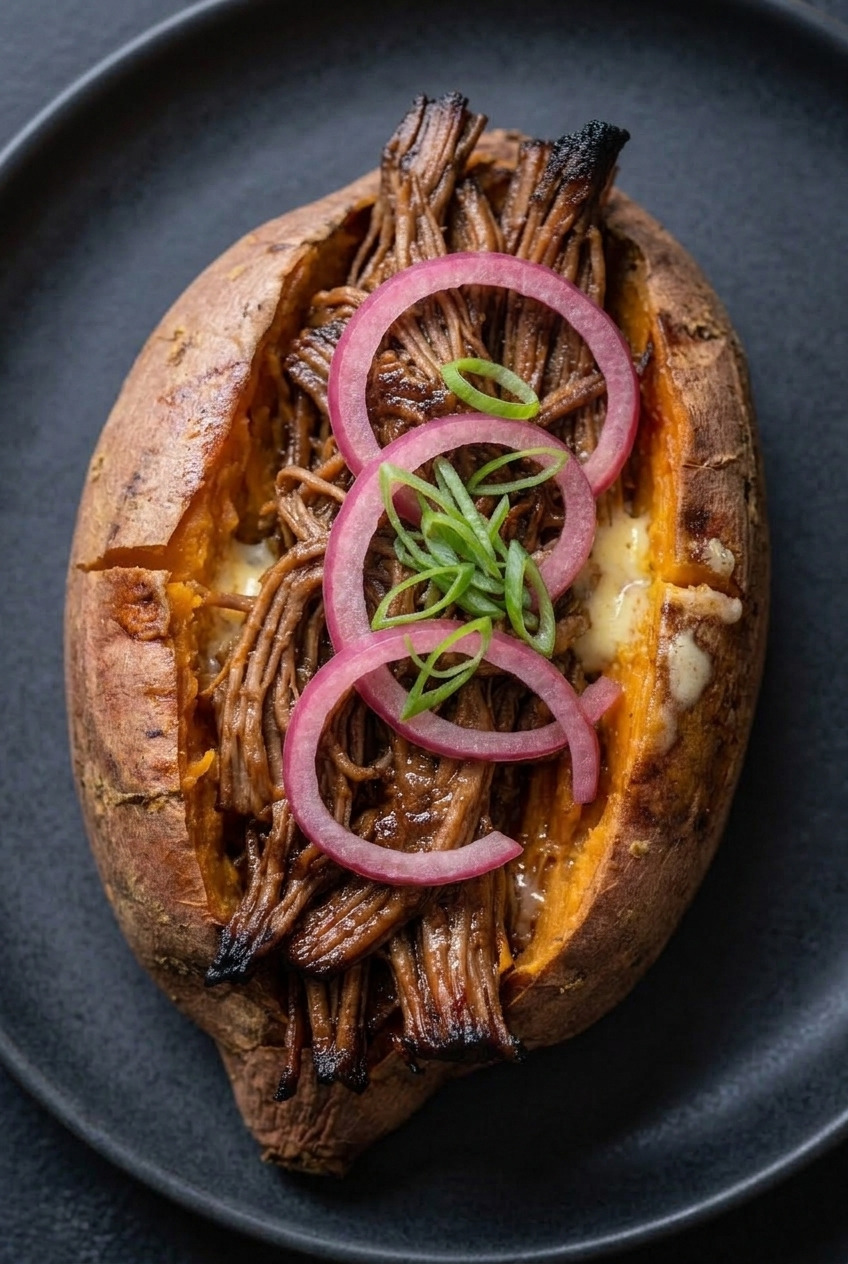
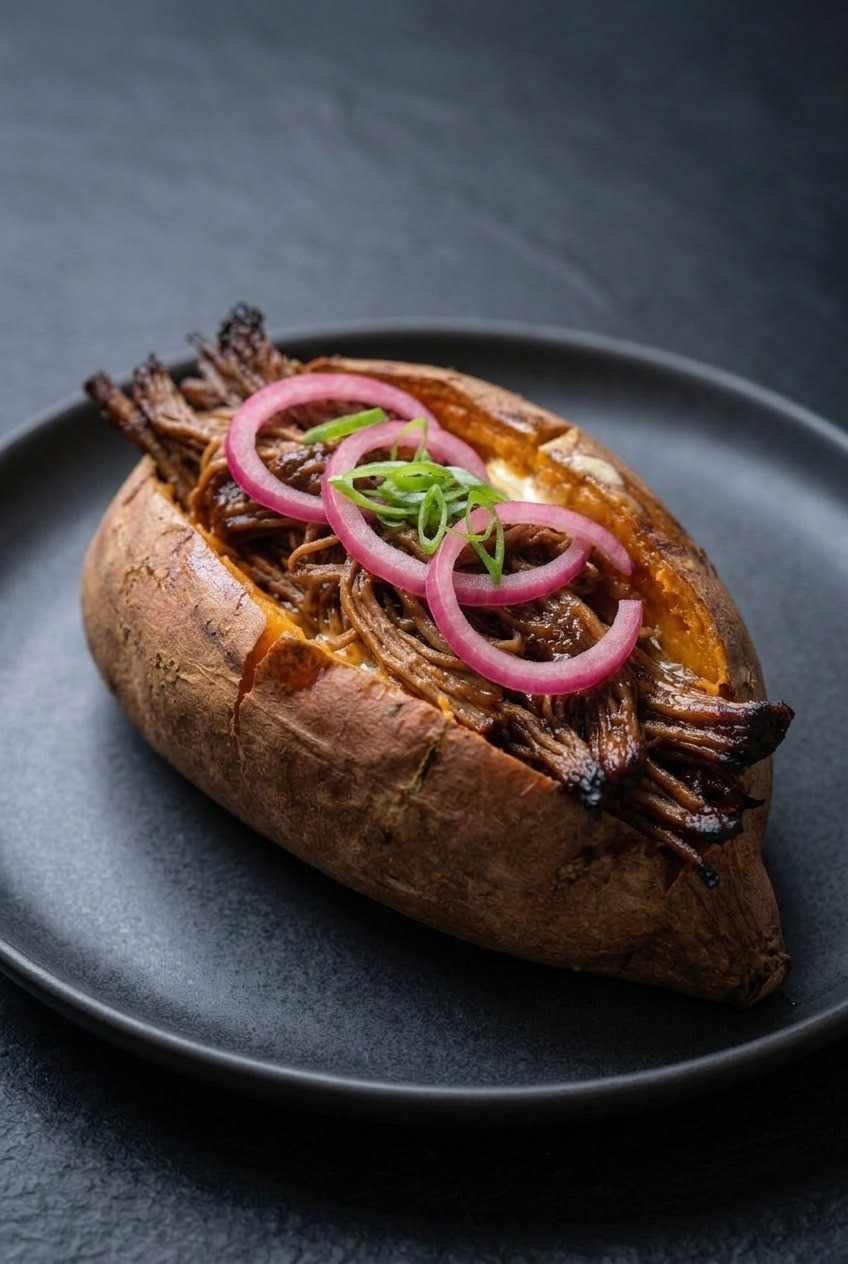
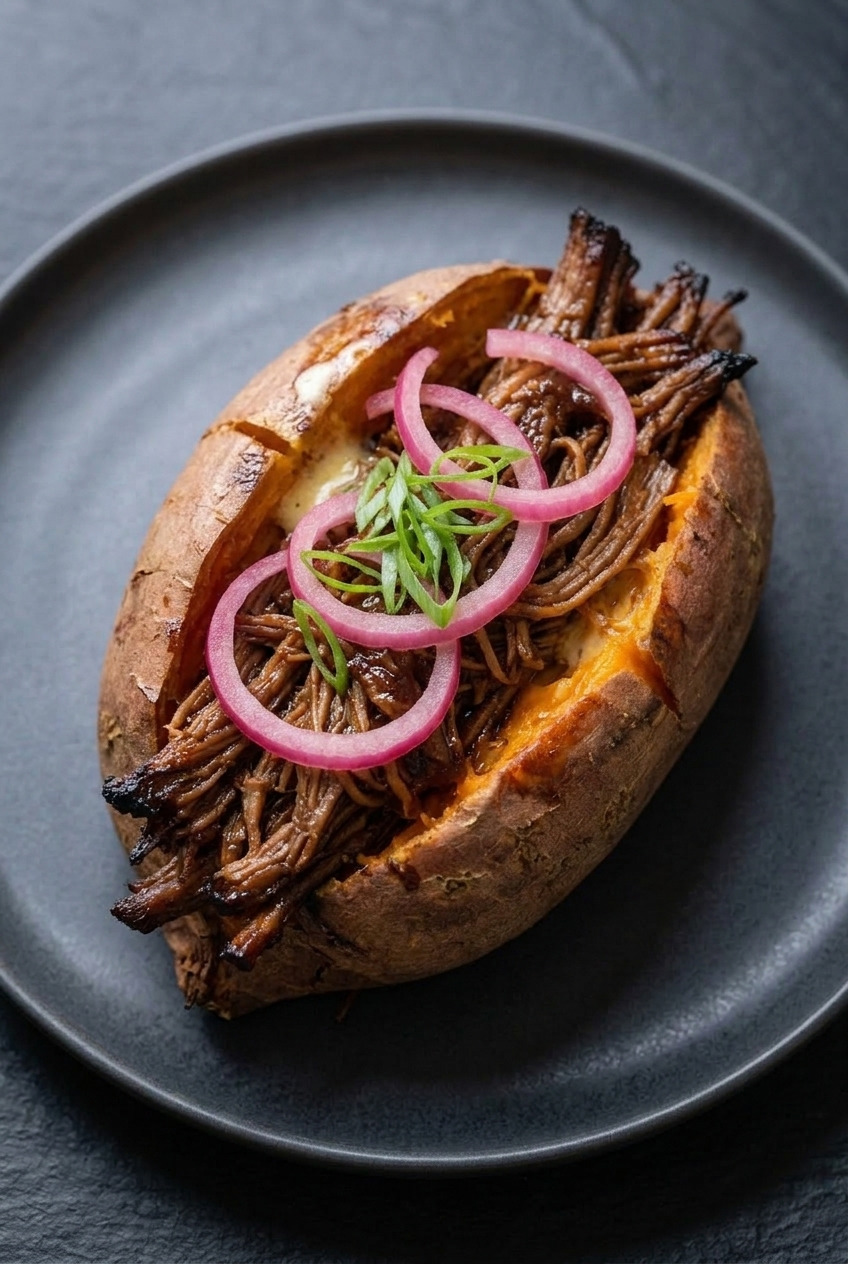
I split them, work a little butter into the hot flesh with a fork, and pile the pork in with some of its own skimmed juices stirred into the sauce.
Then quick pickled red onions on top, which are not optional in my kitchen.
Rich pork and sweet potato are both soft and both a little sweet, and a plate like that goes cloying in three bites without something sour cutting through it.
Ten minutes in vinegar is all the onions need.
Make them while the shoulder is in the oven.
Why Pork Shoulder and Sweet Potato Work Together
This pairing is a fat and sugar problem, solved with acid. Pork shoulder is one of the fattiest cuts on the animal, and a baked sweet potato is one of the sweetest vegetables in the store.
Put them together with nothing else and you get richness stacked on richness.
Which is delicious for about four bites, then heavy.
Everything sharp in this recipe exists to fix that, the cider vinegar in the braise, the vinegar in the sauce, and the pickled onions on top.
Keep all three and the plate stays interesting to the last forkful.
Stuffed, Not Twice Baked
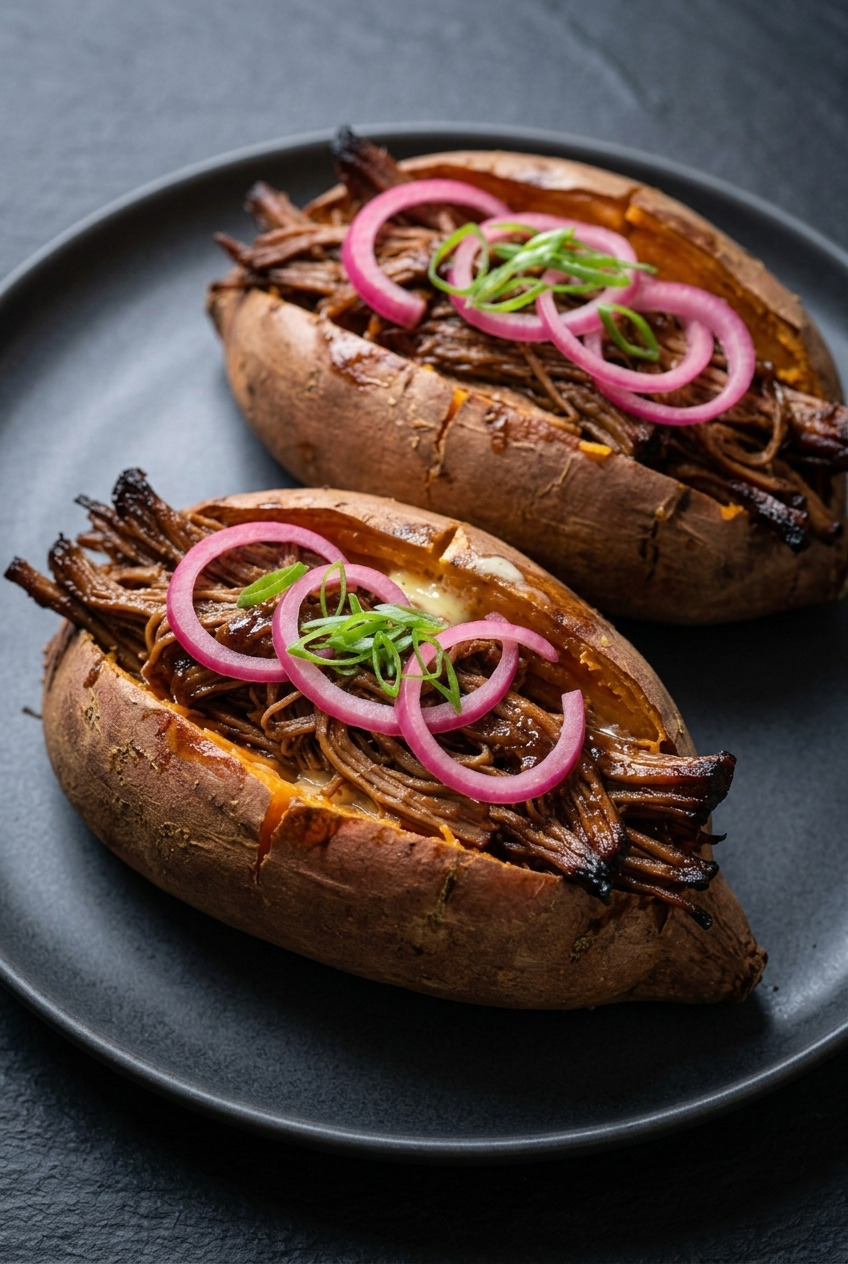
Worth stating clearly, because the two names get swapped around. A stuffed sweet potato is baked whole, split, and filled. The flesh stays where it grew.
A twice baked one is scooped out, mashed with things, packed back into the empty shell, and baked again.
This recipe is stuffed.
The only thing I do to the flesh is press it open with a fork and work in butter and salt, which builds a bed for the pork rather than mixing with it.
Ingredients You Need
The shoulder is the shopping trip, everything else is a pantry raid.
- Boneless pork shoulder (3 ½ pounds). Also sold as pork butt or Boston butt. Bone in works and gives slightly better juices, just buy about a pound heavier to account for the bone.
- The dry rub. 2 tablespoons brown sugar, 1 tablespoon smoked paprika, 2 teaspoons kosher salt, 1 teaspoon garlic powder, 1 teaspoon onion powder, 1 teaspoon black pepper, ½ teaspoon cayenne.
- Chicken stock (1 cup). Not much. This is a braise, not a boil.
- Cider vinegar (2 tablespoons for the braise). It works on the connective tissue and keeps the finished pork from tasting flat.
- Yellow onion (1, sliced). Goes under the pork and melts into the juices.
- Barbecue sauce (1 cup). Added after shredding, never during.
- Sweet potatoes (4 medium, 8 to 10 ounces each). Buy them close in size so they finish at the same time.
- Butter (2 tablespoons) and kosher salt. For fluffing the potato flesh before the pork goes in.
- Quick pickles. 1 small red onion, ½ cup cider vinegar, 1 teaspoon sugar, ½ teaspoon salt.
- Green onions (3, sliced). The last thing to hit the plate.
The Pork Is the Whole Recipe
Everything good about this dinner happens before the potato is ever involved. Give the shoulder your attention and the rest is assembly.
Buy the right cut. Shoulder, butt, Boston butt, all the same thing. It is laced with fat and collagen, which is precisely what turns into soft, sliceable-then-shreddable meat over hours.
Loin will not work here, ever. It has nothing to give.
Rub it the night before. Mix the rub, coat every surface, and leave it uncovered on a rack in the fridge overnight.
The salt seasons deeper than the surface, and the exposed air dries the outside so it browns instead of steaming.
Short on time? An hour on the counter is better than nothing.
Cut it into three pieces. More surface area means more browned crust, and three fist-sized chunks cook faster and more evenly than one dense block.
Braise it low and covered. Onions in the bottom of a Dutch oven, pork on top, stock and vinegar poured around it, lid on, 300°F for about 4 hours.
The liquid should come about a third of the way up the meat, no higher.
It is done when a fork twists freely. Not at a temperature you read on a chart, though you will find it lands somewhere around 200°F. If the fork meets resistance, it needs another 30 minutes, and no amount of staring at it will speed that up.
Rest, then shred. Twenty minutes on a board, then two forks, pulling with the grain and then across it.
Defatting Is the Step Nobody Mentions
A shoulder throws off a lot of fat, and pork sitting in it goes greasy. This is the difference between rich and heavy, and I have never seen it in another recipe for this dish.
Pour the braising liquid into a tall glass measuring cup or a fat separator.
Give it 10 minutes.
The fat rises into a thick pale layer you can spoon straight off, and what is left underneath is concentrated pork stock with the onions dissolved into it.
That defatted liquid is gold.
Stir ½ cup of it into the shredded pork along with the sauce and the meat goes glossy instead of oily.
Oven Braise or Slow Cooker
Both work, and they are not the same. I use the oven, but I will not pretend the slow cooker is wrong.
- Oven braise, 300°F for 4 hours. Dry heat around the pot browns the exposed top of the meat while the bottom simmers. You get a darker, more savory result with actual bark on the edges.
- Slow cooker, low for 8 hours. Everything steams. The pork is just as tender and slightly milder, and you can leave the house. Brown the pieces in a skillet first or the color will be pale and the flavor thin.
- Liquid changes. A slow cooker loses almost no moisture, so cut the stock to ½ cup or you will be draining a swimming pool.
- Either way, defat. Especially the slow cooker, which renders even more fat into the pot.
Saucing After the Shred
Sauce belongs at the end, and the reason is chemical, not fussy. Barbecue sauce is mostly sugar and tomato, and eight hours of heat turns that sugar bitter and dull.
Shred first.
Then stir in 1 cup of barbecue sauce and ½ cup of the defatted braising liquid.
The ratio I like is enough sauce to coat and just enough liquid to keep the strands loose.
Dry pork on a plate is the most common complaint about this dish, and it almost always means someone drained the pot.
Keep the juices, always.
Baking the Sweet Potatoes
One short section, because this is the easy part. Heat the oven to 425°F once the pork comes out.
Scrub the potatoes, prick them several times, rub the skins with oil and salt, and set them on a foil-lined sheet pan without wrapping them.
Bake 45 to 55 minutes until a knife meets no resistance.
Split them, then work ½ tablespoon of butter and a pinch of salt into each one with a fork.
Seasoning the flesh matters here more than in most stuffed potato recipes, because a heavily sauced pork on top of a completely bland base is an odd bite.
How to Make Barbecue Pulled Pork Stuffed Sweet Potatoes
Step 1: Rub the Pork
Cut the shoulder into three pieces, coat with the rub, and refrigerate uncovered overnight on a rack.
Step 2: Braise It Low
Onions in the pot, pork on top, stock and vinegar around it, lid on, 300°F for 4 hours until a fork twists freely.
Step 3: Rest, Shred and Defat
Rest the meat 20 minutes. Skim the fat off the strained liquid, then shred the pork with two forks.
Step 4: Bake the Potatoes
Raise the oven to 425°F and bake the oiled, salted potatoes 45 to 55 minutes.
Step 5: Sauce, Fill and Finish
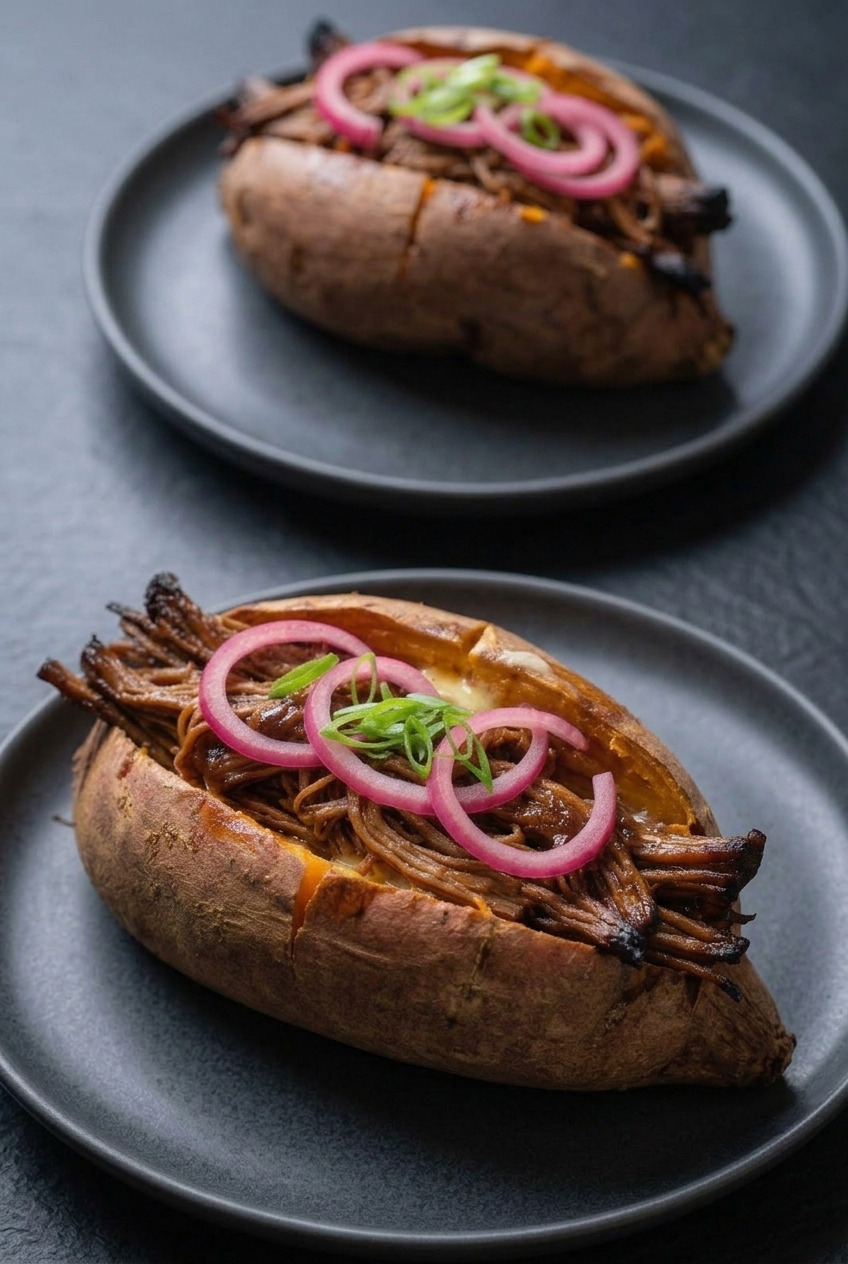
Toss the pork with sauce and defatted juices, split and butter the potatoes, fill them, then top with pickled onions and green onions.
Quick Pickled Red Onions
Ten minutes, four ingredients, and they change the entire plate. Make them first and forget about them.
- Slice thin. A sharp knife or the thinnest setting on a mandoline. Thick rings stay harsh.
- Warm the vinegar. Heat the cider vinegar with the sugar and salt just until they dissolve, then pour it over the onions in a jar.
- Wait 10 minutes. They turn bright pink and go from raw to snappy and sour. An hour is better, overnight is best.
- They keep 2 weeks. In the fridge, in their liquid. I always have a jar going.
Short on time? My barbecue chicken stuffed sweet potatoes get you the same plate on a weeknight.
Using Up the Rest of the Shoulder
Four potatoes will not finish 8 cups of pork, and that is the plan. Here is where the rest of mine goes.
- Crisped in a hot skillet. A thin layer of pork pressed into a dry pan until the edges go brown and crunchy, then piled onto eggs.
- Tacos. Warm corn tortillas, the pickled onions from this recipe, chopped cilantro. Twenty minutes on a Tuesday.
- Frozen in portions. Two cup bags with a splash of the braising liquid in each so they reheat without drying.
Not another stuffed potato, though.
Twice in a week is once too many, and I learned that the hard way.
Plenty of shoulder left? Sliders are the obvious next move, and these slow cooker pulled pork sliders do it hands-off.
Storage and Reheating Without Drying It Out
- Store pork in liquid. Always. Sauce, juices, or both. Bare pulled pork in a container dries into straw by day two.
- Fridge, 4 days. Pork and potatoes separately, potatoes whole and unsplit.
- Freezer, 3 months. Pork only. Baked sweet potatoes freeze badly and come back stringy.
- Reheat low and covered. A skillet over low heat with a splash of liquid and a lid, or 325°F in a covered dish. High heat squeezes the strands tight.
- Reheat potatoes at 400°F for 15 minutes. The skin dries back out. A microwave leaves it damp.
Cook the shoulder on a Saturday.
Eat it Sunday, then twice more during the week, and you will understand why I keep doing this.
Recipe
Slow Braised Pulled Pork Stuffed Sweet Potatoes
Ingredients
For the Pork and Rub
- 3 ½ pounds boneless pork shoulder cut into 3 large pieces
- 2 tablespoons brown sugar packed
- 1 tablespoon smoked paprika
- 2 teaspoons kosher salt
- 1 teaspoon garlic powder
- 1 teaspoon onion powder
- 1 teaspoon black pepper freshly ground
- ½ teaspoon cayenne pepper
For the Braise and Sauce
- 1 yellow onion sliced
- 1 cup chicken stock use ½ cup in a slow cooker
- 2 tablespoons cider vinegar for the braise
- 1 cup barbecue sauce plus more for the table
For the Sweet Potatoes and Finishing
- 4 medium sweet potatoes 8 to 10 oz each, scrubbed
- 2 teaspoons olive oil for the skins
- ½ teaspoon kosher salt for the skins
- 2 tablespoons butter for fluffing the flesh
- 1 small red onion very thinly sliced
- ½ cup cider vinegar for the pickles
- 1 teaspoon sugar for the pickles
- ½ teaspoon kosher salt for the pickles
- 3 green onions thinly sliced
Instructions
Rub and Braise the Pork
- Cut the pork shoulder into 3 large pieces. Mix the brown sugar, smoked paprika, salt, garlic powder, onion powder, black pepper and cayenne, then coat every surface of the meat.
- Set the pork on a rack over a tray and refrigerate uncovered overnight if you can, or leave it 1 hour at room temperature. The dry surface browns instead of steaming.
- Heat the oven to 300F. Scatter the sliced yellow onion in a Dutch oven, set the pork on top, and pour the chicken stock and 2 tablespoons cider vinegar around it. The liquid should reach about a third of the way up the meat.
- Cover and braise 4 hours, until a fork twisted into the meat turns freely with no resistance. If it resists, give it another 30 minutes.
Rest, Defat and Shred
- Move the pork to a board and rest 20 minutes. Strain the braising liquid into a tall measuring cup and let it settle 10 minutes, then spoon off the pale fat layer that rises to the top.
- Shred the pork with two forks, pulling with the grain and then across it. Discard any large fat seams.
- Stir the barbecue sauce and ½ cup of the defatted braising liquid through the shredded pork until it is glossy and loose, not swimming.
Potatoes, Pickles and Assembly
- Warm the cider vinegar with the sugar and salt until dissolved, pour over the sliced red onion in a jar, and leave at least 10 minutes.
- Raise the oven to 425F. Prick the sweet potatoes, rub the skins with olive oil and salt, and bake unwrapped on a foil-lined sheet pan for 45 to 55 minutes, until a knife meets no resistance.
- Split each potato lengthwise, press the ends together to open it, and work ½ tablespoon of butter and a pinch of salt into the hot flesh with a fork.
- Fill each potato with the sauced pork, top with drained pickled red onions and sliced green onions, and serve.
Notes
- Cut matters: shoulder, butt and Boston butt are the same cut. Pork loin will not work, it has no collagen to break down.
- Defat the liquid: skim the fat and stir the concentrated juices back into the pork. This is the difference between rich and greasy.
- Slow cooker option: brown the pieces first, use only ½ cup stock, and cook on low for 8 hours.
- Sauce at the end: barbecue sauce cooked for hours turns bitter, so add it after shredding.
- Doneness: a fork that twists freely, roughly 200F internal. Time is a guide, the fork is the test.
- Storage: keep pork in its liquid, fridge 4 days, freezer 3 months in 2 cup portions with a splash of juices. Reheat low and covered.