
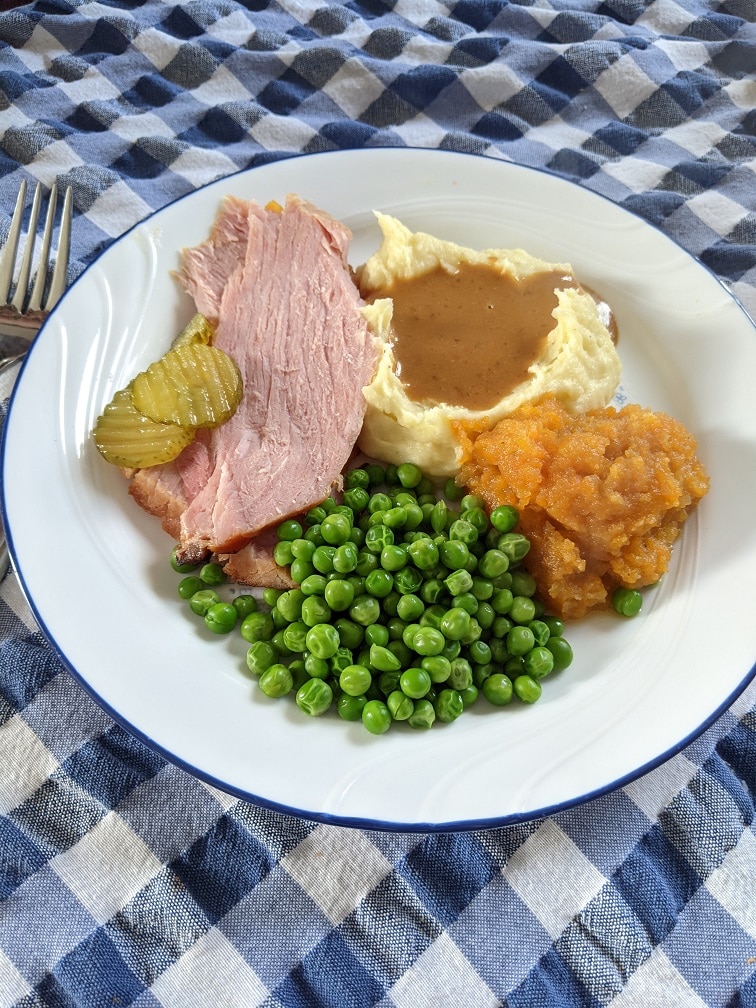
It's early on a Sunday morning. The oven has just finished preheating, and in goes a large smoked ham. Within an hour, your house is filled with the smell of hickory smoke and roasting meat. Before long, the windows are steamed from the sides boiling away on the stove. In no time at all, you and your family are sitting down to a large Sunday lunch, and in a moment of perfect happiness, you take the first bite of your ham dinner. Join me as I share with you my Classic Ham Dinner With All the Fixings.

The Sides
Mashed Potatoes
I love mashed potatoes so much that I've written not one but two dedicated posts about them. You can check them out here and here. When it comes to mashed potatoes, I prefer to push the potatoes through a food mill instead of using a hand masher. The food mill gives the potatoes a uniform smooth texture, exactly what I want from my mashed potatoes.
Another secret of mine for great mashed is to use whipping cream instead of milk (and heat it before adding it to the potatoes). The cream adds a richness to the potatoes that just can't be beaten. Of course, I save the creamy potatoes for special occasions. Other than that, lots of butter, salt and pepper, and you will have perfect potatoes every time.


Mashed Turnip and Carrot
Mashed carrot and turnip are one of my all-time favourite side dishes for a big roast dinner. The saltiness of the ham is balanced perfectly by the sweetness from this side dish. To make it, peel and dice equal parts carrot and turnip (or rutabaga). Put the vegetables in a pot, cover with water, and boil until tender. Drain the vegetables and mash well. Add a tablespoon or two of butter to the mashed veg along with a tablespoon or two of brown sugar, a big pinch of salt and pepper, and a small pinch of nutmeg. You really just cannot go wrong with mashed carrot and turnip.


Peas
The only thing I can say about peas is not to overcook them. Peas should be bright green and pop when you bite into them. And yes, I used frozen peas for this. I put the peas in a pot of water, brought them to a boil, and let them cook for about three minutes before draining them. That is all the time they need. Once the peas are drained, stir into them a tablespoon or two of butter and a big pinch of salt and pepper.

Red-Eye Gravy
Red-eye gravy is a staple of ham dinners in the Southern United States. It is made of ham drippings and strong coffee. The traditional version generally has a watery consistency similar to au jus. For my version, I wanted a more gravy-like consistency, so I thickened it with a roux.
To make my gravy, I started by melting two tablespoons of butter, to which I added two tablespoons of gluten-free all-purpose flour. I whisked this mixture over moderate heat for about three minutes before adding in two shots of espresso. The roux and the espresso made a thick paste, which made the perfect base for my pan drippings from the ham. I whisked until the gravy was a smooth, thick consistency, then added whole milk until I got the gravy consistency I wanted. The gravy was a little sweet from the honey glaze, slightly bitter from the coffee, creamy from the roux and the milk, and a bit salty from the ham. All that is to say that it was delicious. If you're interested in learning more about building great sauces and gravies, have a look at my post on sauce making.


Honey Roasted Ham
Type of Ham
The ham I used for my ham dinner was a shank-in hickory-smoked ham. It was already fully cooked but needed to be heated through. I was lucky enough to get it on sale right after Thanksgiving, so this 4.6 kg ham (10 lb) was only $15.22. When I saw it in the grocery store, I couldn't say no. Not only was I craving a ham dinner, I couldn't help but think of all the wonderful things I can make with the leftovers-from broccoli and ham pasta to western sandwiches, to split pea and ham soup. The possibilities are endless. If you're looking for more ideas for cooking larger cuts of meat, my guide on cooking meat covers all the fundamentals.

Roasting the Ham
In all honesty, it is not very often that I roast a whole ham. So, for cooking advice, I turned to the instructions written on the package. They said to roast the ham at 325°f for 15-20 minutes per pound. For my ham, that works out to be about three and a half hours. For the first two hours of cooking, I did nothing to the ham. I didn't season it or anything. I did score the ham's surface with a sharp knife before putting it in the oven, but that's it.


Honey Glaze
After the first two hours of cooking my ham, I glazed it with a mixture of equal parts honey and hot water, combined with a pinch of nutmeg. I glazed the ham at the two-hour mark and the three-hour mark. In total, the glaze was about ½ cup honey, ½ cup water, and ¼ teaspoon of nutmeg. Once the ham was heated through, I let it sit for twenty minutes before cutting into it.


Final Thoughts
As much as I love a big bowl of pasta or spicy fried rice, there is something to be said for a classic roasted ham dinner with all the fixings. It feels homey and comforting, especially on a cool fall day. This is one of those meals I look forward to every year, and the leftovers alone make it worth the effort.

Steve Jarvis says
This article has a small mistake. Rutabaga is a swede not a turnip, two very different beasts. I love mashed carrots and swede with salt, butter and loads of pepper.
Chef Ben Kelly says
It kind of depends on where you are in the world. I live in Canada and we don't call anything a swede or a rutabaga. Everything is a turnip.
Judy says
This all sounds very tasty,One of the things my Mother in law did and I continue to do is serve fried eggs with our dinner with homemade mustard.This year I plan to try the gravy.Looks very good.