
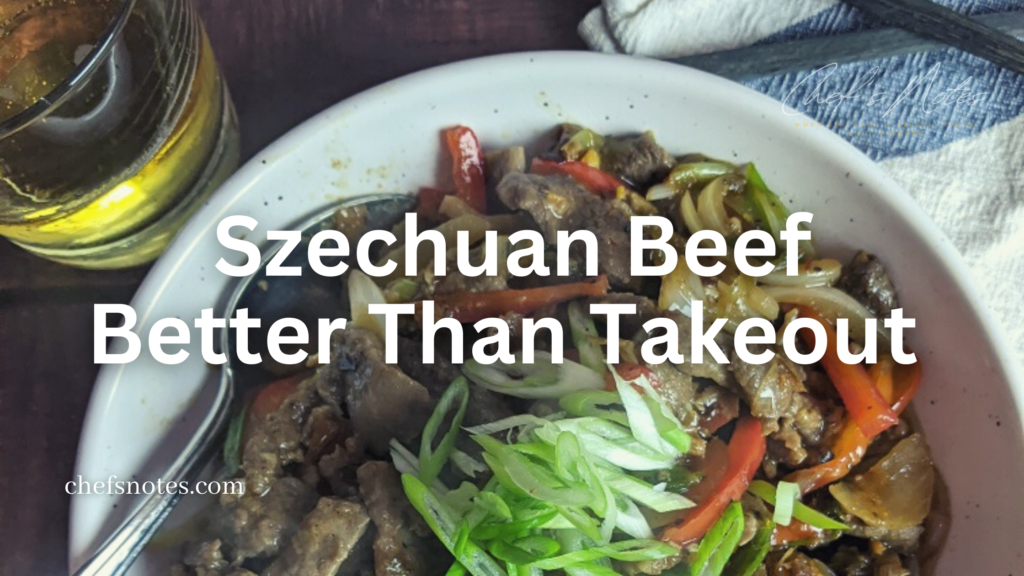
Szechuan Beef is a dish that is often considered very spicy and comes in many different forms. Today I will share a Gluten-Free Szechuan Beef recipe that delivers all the warmth and tingle of authentic Szechuan cooking without the burn. If you're ready to make homemade Szechuan Beef that is better than take-out, let's get to it.
Jump to:
What is Szechuan?
In most Chinese restaurants, the name Szechuan denotes a spicy dish laced with chilli peppers. And in truth, the Szechuan province of China is known for its spicy food. However, up until chilli peppers were introduced to the area in the 15th or 16th century, and even to this day, much of the spiciness in Szechuan food comes not from chillies but the Szechuan peppercorn.
Despite the name, Szechuan peppercorns aren't actually pepper. They aren't related to pepper or chillies at all. They do, however, look similar to peppercorns and produce a warming of the mouth. The main difference in flavour between a Szechuan peppercorn and either regular pepper or chilli pepper can not be overstated. Where peppercorns and chillies burn or even sting the mouth, Szechuan peppercorns warm, tingle and slightly numb the mouth in an enjoyable way.
You can find Szechuan peppercorns in most bulk food stores or specialty Asian or Chinese groceries in the spice aisles. To the best of my knowledge, there is no equal substitute for Szechuan peppercorns. Szechuan peppercorns are one of the spices in the spice blend, Chinese Five Spice.

The Beef
For my Szechuan beef recipe, I used about half a pound (224g) of sirloin tip. You can use just about any cut of beef you want for this. The meat is cut so thin and marinated that it will be tender no matter what. But keep in mind that you must cut across the grain.
The grain of the meat is the direction in which the muscle fibres grow, similar to the grain of a piece of wood. This will change from muscle to muscle. The idea is that you want to shorten those muscle fibres by cutting across them rather than with them. This makes the meat more tender and easier to chew.
With the sirloin that I used, I had to cut it into three separate pieces because the grain was going in three separate directions. Then I cut those three pieces across the grain. This extra step makes a world of difference to the finished product. Cut the beef no more than 5 mm thick.


Marinating The Beef
The beef for our Szechuan beef needs to be marinated for at least an hour. Two hours is better. The marinade for the beef is:
- A teaspoon each of chopped ginger and garlic
- Two tablespoons of tamari
- A quarter teaspoon of fresh cracked black pepper
- One egg white
- One tablespoon of cornstarch
Mix all of this up in a bowl with the sliced beef, cover it with plastic, and put it in the fridge for an hour or two.


Vegetables
Szechuan Beef isn't just beef. That would be a little boring. So, we need a few vegetables:
- Half a red bell pepper, seeds and ribs removed, sliced as thin as you can
- One small onion, peeled and thinly sliced
- Two green onions, washed and thinly sliced
- About a tablespoon each of finely chopped garlic and ginger


The Sauce
The Szechuan Beef also needs a sauce. To make the sauce combine one tablespoon of sugar with two tablespoons of tamari, one tablespoon rice vinegar, one teaspoon Sambal Oelek (can be found at most grocery stores or can be substituted with Sriracha), two tablespoons of water, and a pinch of salt. Stir the sauce together and set aside until you're ready for it.


Other Flavours
It's almost time to start cooking the Szechuan Beef, but we need our two key ingredients before we get going on that. They are Szechuan peppercorns and dried red chilli.
If you can't find Szechuan peppercorns, use a teaspoon of Chinese five-spice. It will slightly change the flavour of the dish, but not in a bad way. Use one tablespoon of Szechuan peppercorns and grind them in a spice grinder or a mortar and pestle. This should give you about a teaspoon of ground Szechuan pepper. Mix the ground Szechuan peppercorns with a teaspoon of dried red chilli flakes.


Cooking The Szechuan Beef
Before we get cooking, let's talk about what I'm cooking with. I opted to use a large non-stick pan rather than a wok for this for two reasons. The first reason is that most people probably have a large non-stick pan, where they don't have a wok. Second of all, because of the egg white and cornstarch coating on the meat, it tends to stick to a wok's surface unless it is non-stick. I thought that using the non-stick pan would be better for the demonstration and for cooking this dish. Of course, if you prefer to use a wok, go for it.
Cooking The Beef
The way to prepare this so that the beef remains tender and doesn't become overcooked is to cook in stages. Stage one is to cook the beef. To do that, heat a pan or wok over medium-high heat. My stove goes to nine. I had the dial set to eight. Let the pan heat thoroughly. When you splash a little water on it, it should sizzle and roll away.
Add one tablespoon of cooking oil to the pan (ensure there is no water in the pan before adding the oil). I used canola oil, but any oil will do. Spread the oil around the pan and add the beef. Let the beef sit for at least one minute before stirring or tossing it. Move it around and let it sit for another minute. Cook the beef only until it is golden brown, then take it out of the pan. It should only take three to four minutes. Don't worry about cooking the beef all the way through. Just get a little colour on it.


Building The Flavour
Put the pan back on the heat, and add in another tablespoon of oil along with the ginger and garlic. Cook the ginger and garlic for about a minute, then add in the ground Szechuan peppercorns and chilli. Cook for forty-five seconds to a minute.


Stir-Frying the Vegetables
After the Szechuan pepper and chilli have been in the pan for about a minute, add all of the vegetables. Normally, I would suggest doing this in stages (if you are making a double batch of the recipe, add the onions and green onions first, cook for three minutes, then add in the red peppers) to maintain the heat of the pan. However, because the amount of vegetables we are using does not cover the pan's whole surface, it won't cool down too much. We actually want the pan's temperature to drop slightly so the garlic, ginger, pepper, and chilli don't burn.
Throughout this whole cooking process, I do not turn the temperature down. You must not either. If you feel like your pan is getting too hot or your food is burning, keep stirring the food, lift the pan off the heat for thirty seconds, and then put it back down. The pan needs to retain the majority of its heat. If the pan cools down too much, moisture coming off the vegetables will hit the surface and pool rather than evaporate. If this happens, our stir-fry will become a stir-boil, which no one wants.


Adding The Beef Back In and The Sauce
The final step to making this Szechuan Beef is to add the partially cooked beef back into the pan, let it heat back up for a minute or so, then add in the sauce. The cornstarch on the beef will help to thicken the sauce, so there is no need for an additional thickener. Continue to cook for about two minutes or until the sauce thickens.
Remove the Szechuan Beef from the pan to a serving dish, garnish with green onion, and serve with rice.


Recipe
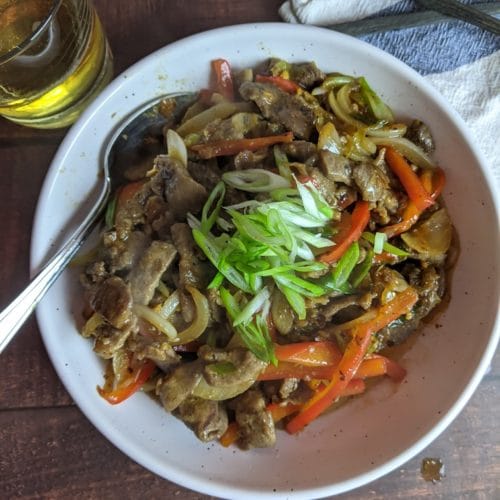
Gluten-Free Szechuan Beef, Better than take-out
Ingredients
Steak Marinade
- ½ lb sirloin steak thinly sliced
- 1 Egg White
- 1 tablespoon Cornstarch
- 1 teaspoon Garlic chopped
- 1 teaspoon Ginger chopped
- ¼ teaspoon Fresh Ground Pepper
Sauce
- 2 tablespoon Tamari
- 1 tablespoon sugar
- 1 tablespoon Vinegar
- 1 teaspoon Sambal
- 2 tablespoon water
- A pinch of salt
Flavourings
- 1 teaspoon Ground Szechuan Pepper Corns
- 1 teaspoon dried red chilli crushed red pepper flakes
Vegetables
- 2 green onions sliced
- 1 small Onion sliced
- ½ Red Bell Pepper seeds and ribs removed, sliced
- 1 tablespoon Garlic minced
- 1 tablespoon Ginger minced
- 2 tablespoon cooking oil
Garnish
- Green Onions Tops
Instructions
- Slice the beef, half a centimetre thick, across the grain.
- Make a marinade of tamari, vinegar, ginger, garlic, pepper, cornstarch and egg white. Mix well, then stir in the beef, cover and put in the fridge for two hours.
- In a small bowl, combine the sugar, soy sauce, sambal, water and salt to make the sauce. Set aside until you are ready to use it.
- Heat a large non-stick frying pan over medium-high heat and add in 1 tablespoon of vegetable oil. Add the beef to the pan and cook for three to four minutes or until golden brown. Take the beef out of the pan and set aside.
- Return the pan to the heat and add another tablespoon of oil along with the second amount of ginger and garlic. Cook for one to two minutes, then add in the ground Szechuan pepper and chilli. Cook for forty-five seconds, then add the vegetables into the pan.
- Stir-fry the vegetables for three to four minutes, then add the beef back into the pan along with the sauce. Cook for two to three minutes or until the sauce is thick.
- Put the Szechuan beef in a serving bowl, garnish with green onions and serve.
Final Thoughts
This Szechuan Beef is one of my absolute favourite take-out-style dishes to make at home, and it pairs beautifully with steamed rice or alongside a bowl of BBQ Pork Chow Mein. The Szechuan peppercorns give it a warmth and tingle that's completely different from regular spicy heat, and in my opinion, this is a must-make.




Beverly Kloppenburg says
Have made this recipe a few times and we love it. I make regularly now and have cut up eight oz portions of flank steak specifically for this. It’s a perfect amount of food for two. My first time using szechuan peppercorns. I’m a huge fan now. Thanks for another super delicious recipe
Chef Ben Kelly says
I'm so glad you like it Beverly. Thank you for the wonderful comment.