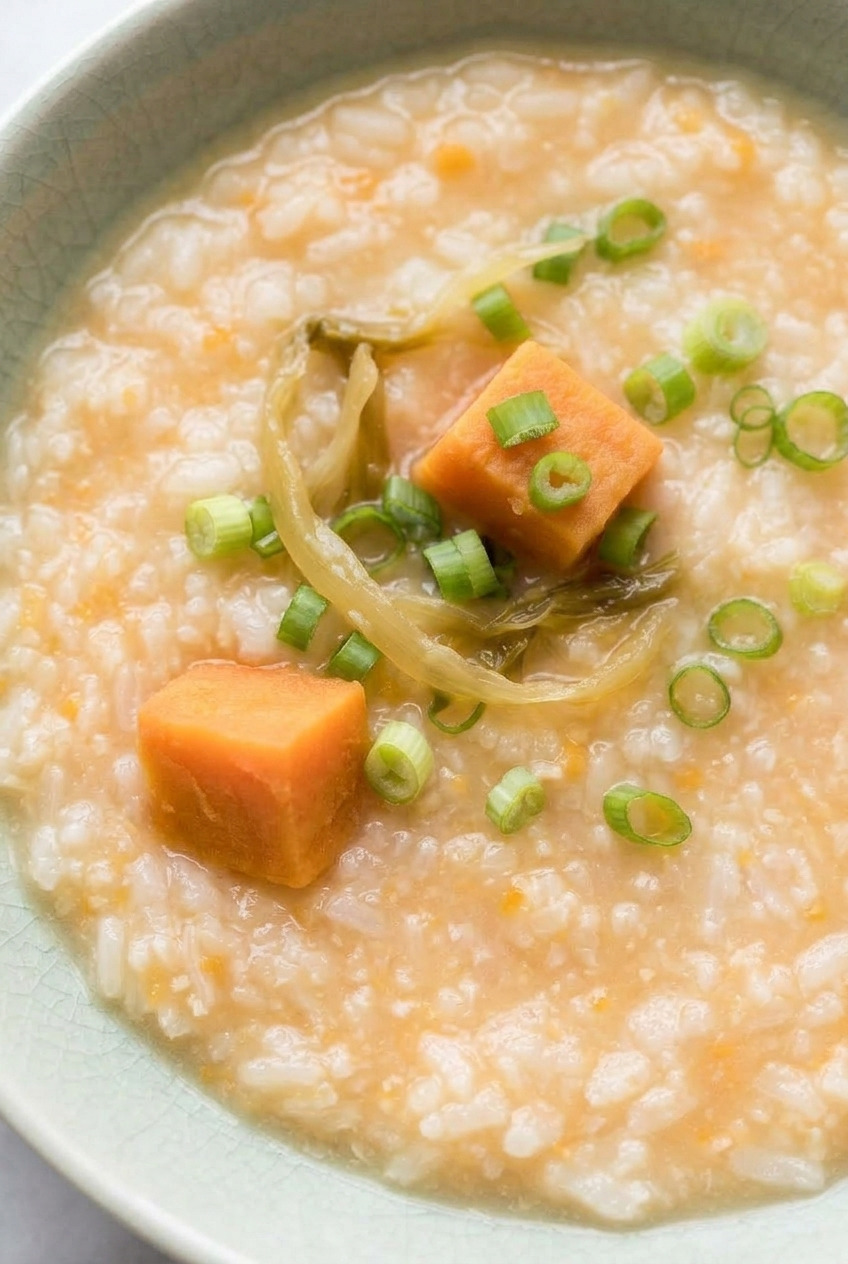
My first attempt at this came out of the pot looking like baby food.
Uniform orange, thick as wallpaper paste, not one recognizable thing in it.
I'd done what the recipe said: everything in a pot, walk away for an hour.
My wife looked at the bowl, then at me, and asked what it was supposed to be.
Fanshu zhou is Chinese sweet potato congee, a loose rice porridge eaten for breakfast across Taiwan and southern China.
Zhou is the porridge. Fanshu is the sweet potato.
Here's the part that surprised me most: it isn't a dessert.
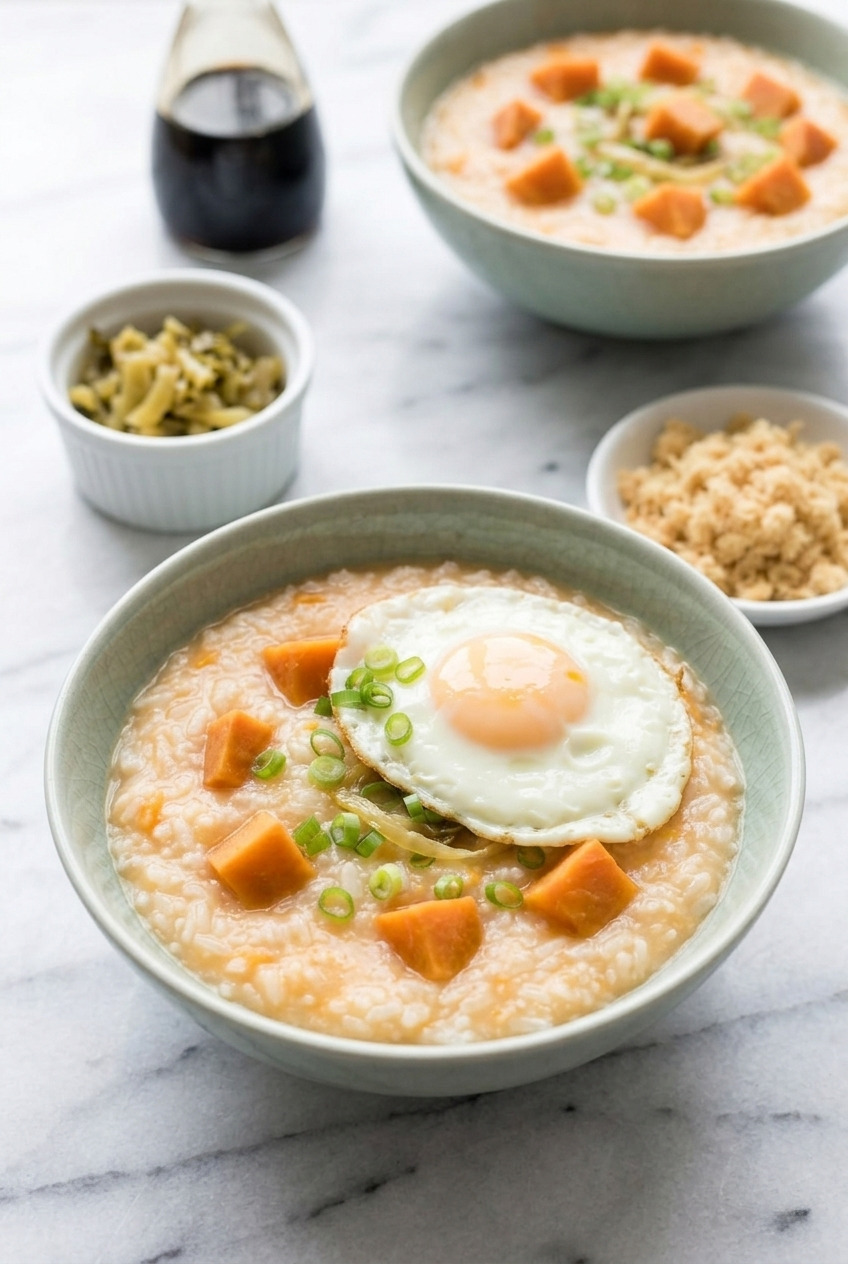
In a Taiwanese home this bowl shows up in the morning, unsweetened, next to a fried egg and a dish of pickled greens and a bottle of soy sauce.
The sweetness is entirely the vegetable's doing.
What fixed my orange paste problem was splitting the sweet potato in two batches.
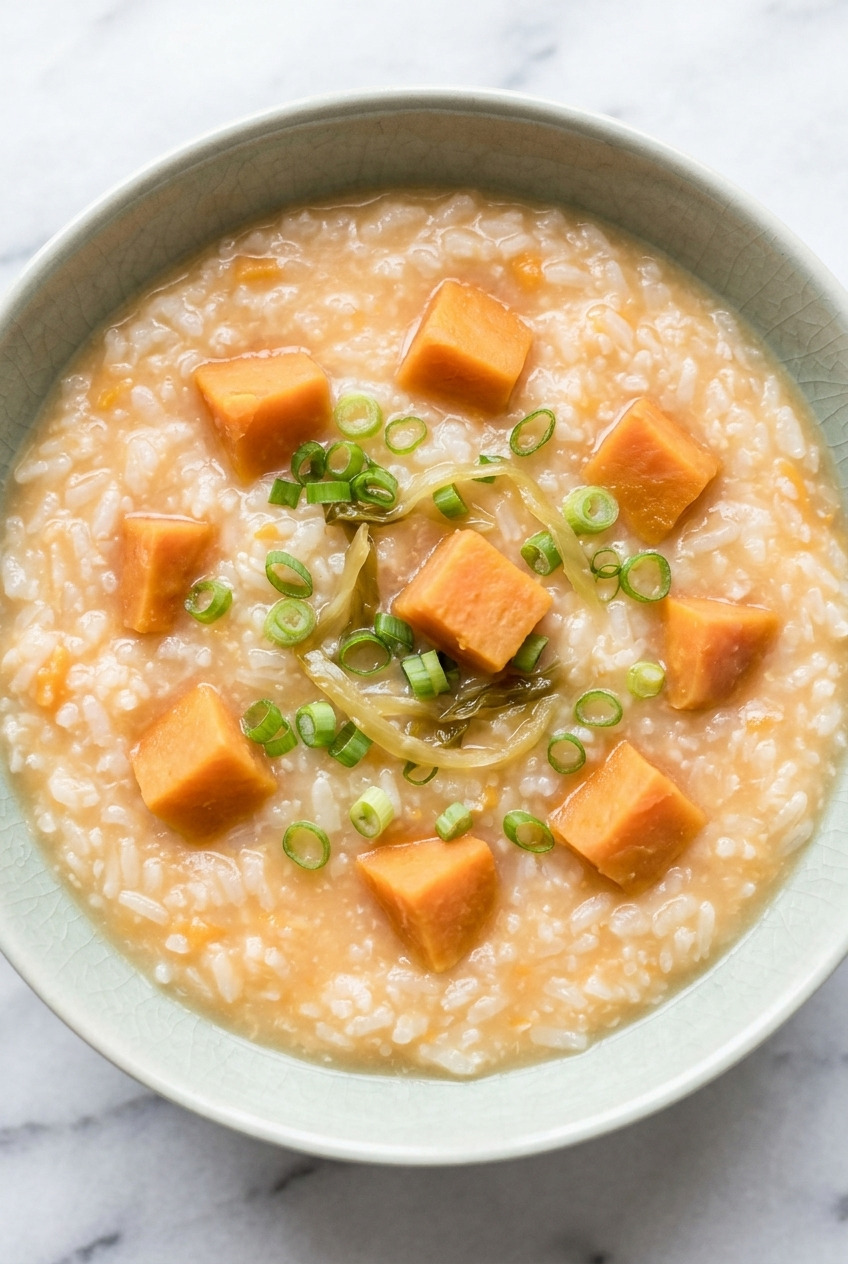
Half goes in at the beginning and melts down into the base, which is what gives the porridge its body and color.
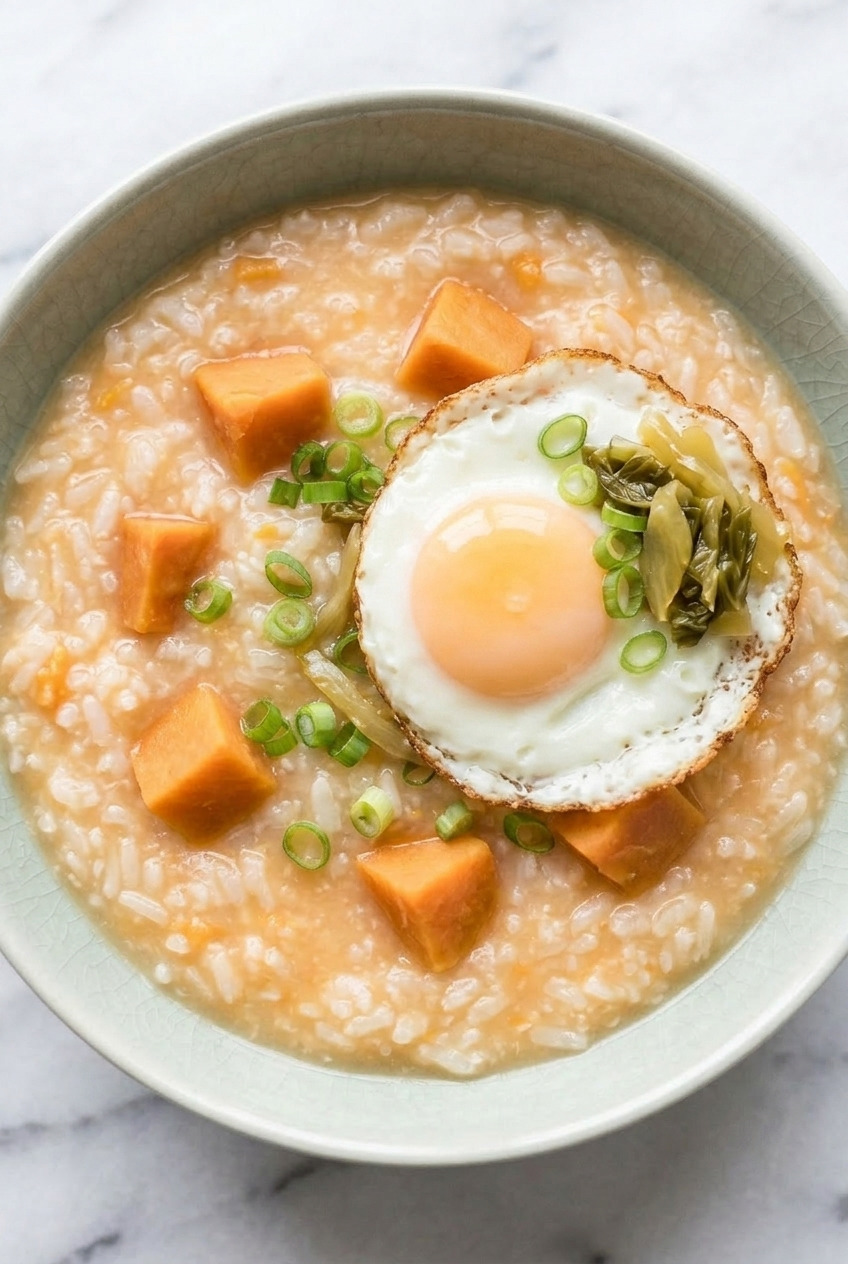
Half goes in for the last 15 minutes, so the finished bowl actually has orange cubes you can see and bite.
One cup of rice, eight cups of water, one sweet potato, and about an hour of mostly ignoring it.
I make it every couple of weeks now, usually on a Sunday morning.
What Fanshu Zhou Is, and When It Is Eaten
Congee is rice cooked in far more water than seems reasonable until the grains burst and go creamy. If you've never had it, think somewhere between a soup and a porridge, savory by default, eaten with a spoon.
It's breakfast food. It's also what gets made when someone in the house is sick, and what turns up at midnight after a long night out.
Sweet potato congee has a particular hold in Taiwan. The island is shaped a little like a sweet potato, and the vegetable carries real cultural weight there as a symbol of getting by and growing anyway.
It shows up in Teochew cooking too, in a looser style where the rice grains stay more distinct instead of collapsing completely.
The honest note about sweetness: a lot of recipes online add honey or rock sugar to this and call it a wellness bowl. That version exists and it's genuinely eaten.
But the everyday bowl, the one made in a Taiwanese kitchen on a Tuesday morning, has no added sugar in it at all.
I'm writing the savory one, with the sweet variation below if you want it.
Rice or Millet?
You'll find this dish made both ways and they're genuinely different bowls. Neither is wrong, they just come from different parts of the country.
- Rice (southern and Taiwanese). Short or medium grain white rice breaks down into a creamy, cohesive porridge. It's mild, it takes on whatever you put on top, and it's the version this recipe is built on.
- Millet (northern Chinese, xiaomi hongshu zhou). Millet gives a thinner, grainier bowl with a faint nutty, almost corn like flavor and a bright yellow color. It cooks faster, around 30 minutes, and it's often the sweetened version.
Want to try the millet one? Swap in ¾ cup of millet for the rice, cut the water to 6 cups, and start checking at 25 minutes.
Ingredients
The base is three things, and the toppings are where the personality lives. Get the rice and the ratio right and everything after that is your call.
About the Key Ingredients
- White rice (1 cup). Short or medium grain is best because it has the starch to go creamy. Jasmine works and is what I usually have. Skip parboiled and skip brown rice, neither breaks down the way you need.
- Water (8 cups). The 1 to 8 ratio is the workhorse for congee. Swapping 2 cups of it for unsalted chicken stock makes a rounder bowl without making it taste like chicken soup.
- Sweet potato (1 pound, about 1 large). Peeled and cut into ¾ inch cubes, and split into two piles. Korean or Japanese sweet potato holds its cube shape better, American orange gets softer and colors the porridge more deeply. Both are good.
- Kosher salt (1 teaspoon). Salt is the whole seasoning here. Add it near the end, because congee concentrates as it cooks and salting early overshoots.
- Fresh ginger (2 thin slices), optional. Simmered whole and fished out. It adds warmth without making the bowl taste of ginger.
What to Serve on Top
The savory set, which is how it's actually eaten:
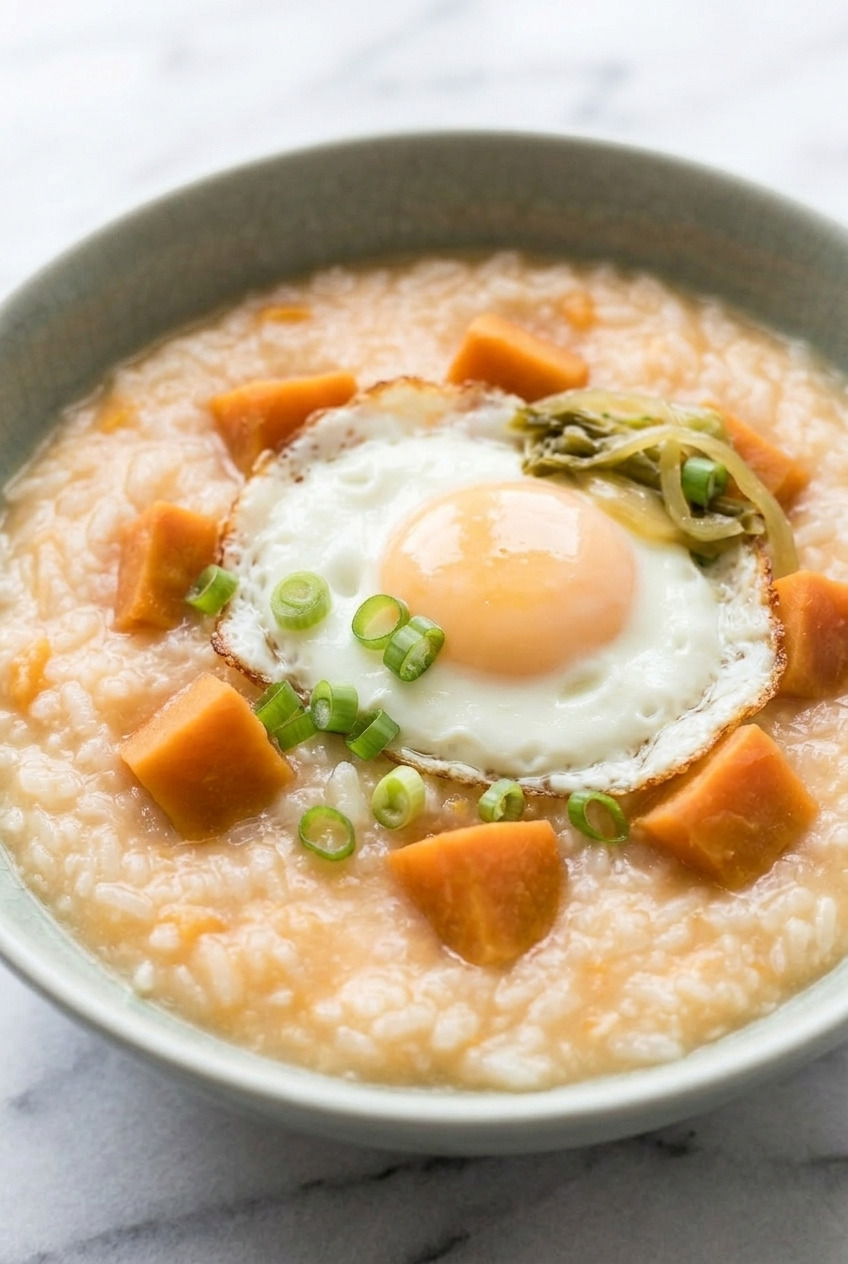
- A fried egg. Crispy edges, runny yolk, laid right on top so the yolk runs into the porridge. This is non negotiable in my house.
- Soy sauce. A drizzle at the table, not stirred in during cooking.
- Pickled mustard greens. Sold in jars or vacuum packs at any Asian market. The sourness cuts through the starch. Any sharp pickle does the job.
- Pork floss (rousong). Fluffy, savory, faintly sweet dried pork. Strange the first time, then addictive.
- Scallions. Thinly sliced, raw, a small handful per bowl.
- Toasted sesame oil. A few drops. That's all you need.
The sweet version, if that's what you're after:
- Rock sugar or honey. Added to taste at the end, roughly 2 tablespoons for the whole pot.
- Dried red dates (6). Slit open and simmered with the rice from the start.
How to Make Sweet Potato Congee
Step 1: Rinse and Soak the Rice
Put the rice in a bowl, cover with cold water, swirl it with your hand, and pour off the cloudy water.
Repeat until the water runs nearly clear, usually three or four rounds.
Then cover it with fresh water and let it soak for 30 minutes.
Worth the wait? Every time. Soaked grains burst more evenly and cut the simmer by roughly a third.
Step 2: Start the Congee
Drain the rice and add it to a heavy pot with 8 cups of water, the ginger slices if you're using them, and half the sweet potato cubes.
Bring it to a full boil, then drop the heat to low so it holds a lazy simmer.
Set the lid on slightly ajar. A sealed pot boils over, and this one will do it the second you leave the room.
Step 3: Simmer and Stir
Cook for 35 minutes, stirring every 10 minutes with a flat edged wooden spoon.
Push the spoon right into the corner where the side meets the bottom of the pot. That's where congee scorches, and once it does the whole batch tastes burnt.
The rice will start collapsing around the 25 minute mark and the first batch of sweet potato will dissolve into the liquid, turning it pale orange.
Step 4: Add the Second Batch
Stir in the remaining sweet potato cubes and cook another 15 minutes, uncovered.
These stay whole. They should be tender enough to cut with a spoon but still hold their edges.
Step 5: Season and Rest
Fish out the ginger. Stir in 1 teaspoon of kosher salt, taste, and add more if it needs it.
Take the pot off the heat and let it sit for 5 minutes. It thickens noticeably as it settles.
Ladle into bowls and pile on the toppings.
The Split Sweet Potato Method
This is the one thing that separates a good bowl from orange wallpaper paste. Sweet potato dissolves. Given 50 minutes in a simmering pot, it will disappear entirely.
That's not a flaw. Dissolved sweet potato is what gives congee its body, its color, and its background sweetness. You want that.
You just don't want only that.
So half the cubes go in at the start and give themselves up to the base. Half go in with 15 minutes left and survive intact.
The result is a pale orange porridge with distinct, tender cubes sitting in it.
Two textures, one vegetable, no extra work.

Tips for the Right Texture
- Stir on a schedule. Every 10 minutes, into the corners. Congee sticking to the bottom is the single most common failure and it's completely preventable.
- Lid ajar, always. Sealed pots boil over, uncovered pots reduce too fast. Ajar splits the difference.
- Thin is normal. It should pour off the ladle in a slow ribbon, not plop. If it's too thick in the pot, it'll be concrete in the bowl.
- Using leftover rice? You can. Use 3 cups of cooked rice with 6 cups of water and cut the simmer to 25 minutes. The texture is a little less silky but on a weekday morning it's a great trade.
- Salt at the end. Congee reduces while it cooks, so salt added early ends up doubled by the time you eat.
- It sets as it cools. Serve it a touch looser than you think you want.
Variations
- Millet version (xiaomi hongshu zhou). The northern Chinese take. Swap the rice for ¾ cup of millet, use 6 cups of water, cook about 30 minutes. Thinner, nuttier, brighter yellow.
- Teochew style. Cut the simmer to 25 minutes so the grains stay whole and separate in a thin, almost broth like liquid. Very different bowl, very good.
- Sweet with red dates. Add 6 slit dried red dates with the rice and finish with rock sugar to taste. Skip the salt and the savory toppings.
- Shredded chicken. Poach a chicken thigh alongside, shred it, stir it in at the end with a splash of the poaching liquid.
- Dried scallop (conpoy). Soak 2 or 3 for an hour, shred them, and add them at the start with the soaking liquid. It's a splurge that makes the bowl taste like a restaurant.
Storage and Reheating
- Refrigerator. Up to 4 days in a covered container.
- It sets solid. Cold congee is basically sliceable, and that's normal. Nothing has gone wrong.
- Reheating. Scoop it into a pot, add ¼ to ½ cup of water or stock per serving, and warm it gently while breaking it up with a spoon. It comes back completely.
- Freezing. It freezes fine for 2 months, though the sweet potato cubes go softer. Thaw overnight and loosen as above.
- Toppings go on fresh. Never store the egg or the pickles in the porridge.
Recipe
Fanshu Zhou (Chinese Sweet Potato Congee)
Ingredients
For the Congee
- 1 cup short or medium grain white rice jasmine also works
- 8 cups water or 6 cups water plus 2 cups unsalted chicken stock
- 1 pound sweet potato about 1 large, peeled and cut into ¾ inch cubes, divided into two equal piles
- 1 teaspoon kosher salt plus more to taste
- 2 thin slices fresh ginger optional, removed before serving
Savory Toppings
- 4 fried eggs one per bowl, yolks left runny
- soy sauce for drizzling at the table
- ½ cup pickled mustard greens or another sharp pickle, chopped
- ¼ cup pork floss (rousong) optional
- 2 scallions thinly sliced
- 1 teaspoon toasted sesame oil a few drops per bowl
Instructions
Rinse and Soak
- Put the rice in a bowl, cover with cold water, swirl with your hand and pour off the cloudy water. Repeat three or four times until the water runs nearly clear.
- Cover the rinsed rice with fresh cold water and soak for 30 minutes, then drain.
Cook the Congee
- Add the drained rice to a heavy pot with 8 cups of water, the ginger slices if using, and HALF the sweet potato cubes. Bring to a full boil.
- Reduce the heat to low so the pot holds a lazy simmer and set the lid on slightly ajar. Cook for 35 minutes, stirring every 10 minutes with a flat edged wooden spoon and reaching into the corner where the side meets the bottom so nothing scorches.
- Stir in the remaining sweet potato cubes and cook uncovered for another 15 minutes, until they are tender enough to cut with a spoon but still holding their edges.
Season and Serve
- Remove the ginger slices. Stir in 1 teaspoon of kosher salt, taste, and add more if needed. Congee concentrates as it cooks, so season at the end rather than the beginning.
- Take the pot off the heat and rest for 5 minutes. The congee thickens as it settles, so it should look slightly loose in the pot.
- Ladle into bowls and top each one with a fried egg, a drizzle of soy sauce, chopped pickled mustard greens, pork floss, sliced scallions and a few drops of sesame oil.
Notes
- The split sweet potato: half at the start dissolves and gives the porridge its body and color, half added in the last 15 minutes stays in visible cubes. Adding it all at once gives a uniform orange paste.
- Stir on a schedule: every 10 minutes, into the corners of the pot. Scorching is the most common failure and it ruins the whole batch.
- Leftover rice shortcut: use 3 cups cooked rice with 6 cups water and simmer 25 minutes.
- Millet version: swap in ¾ cup millet, use 6 cups water, cook about 30 minutes for the northern Chinese xiaomi hongshu zhou.
- Sweet version: add 6 slit dried red dates with the rice and finish with rock sugar to taste instead of salt.
- Reheating: it sets solid in the fridge. Add ¼ to ½ cup water or stock per serving and warm gently, breaking it up with a spoon.