Here is the thing nobody warns you about with homemade burger buns.
They are usually great for about four hours.
Then they go dry, and by the next morning you are toasting them to hide it.
These do not do that.
The reason is ¾ cup of baked sweet potato worked into an enriched dough.
Sweet potato holds onto water the way a sponge does, and it keeps handing that water back to the crumb for days.
Day three, still soft. I have tested this more times than my wife thinks is reasonable.
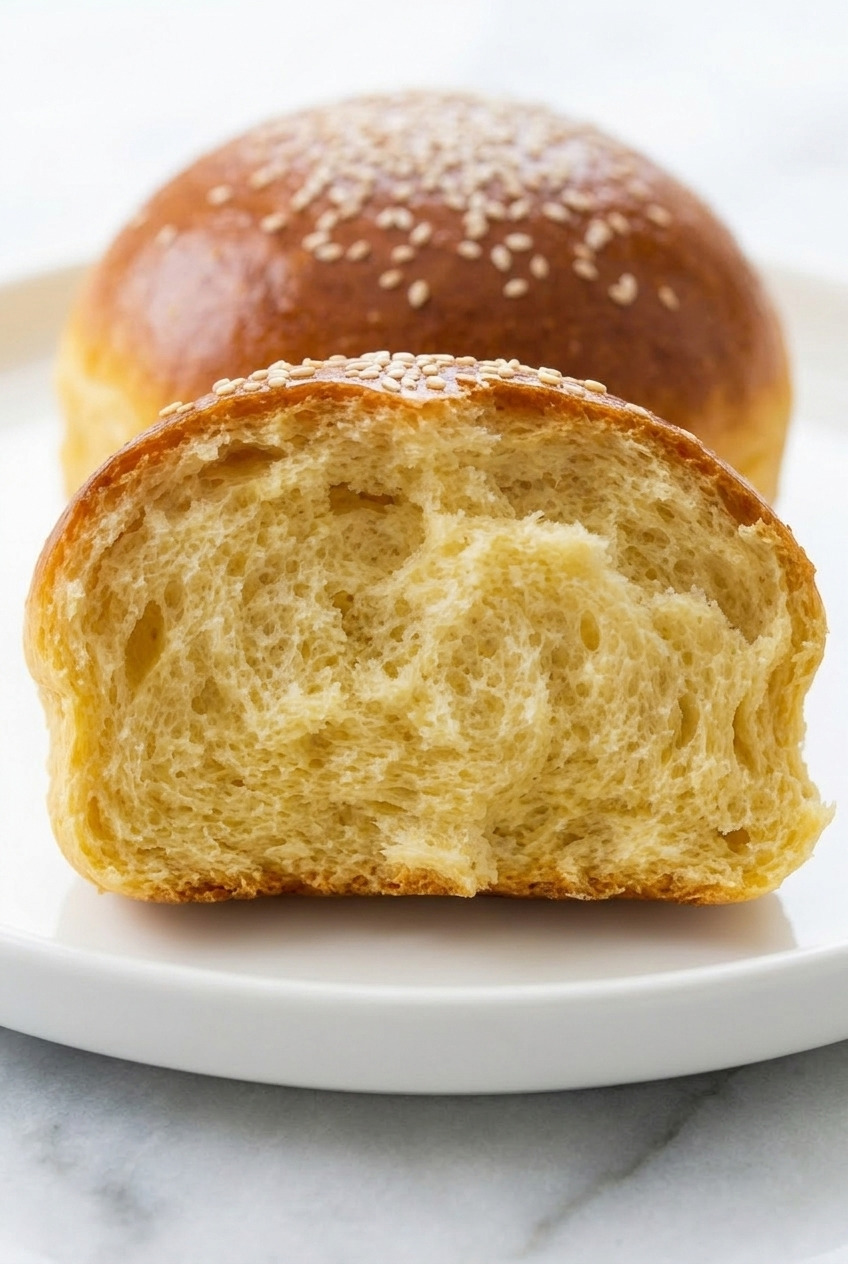
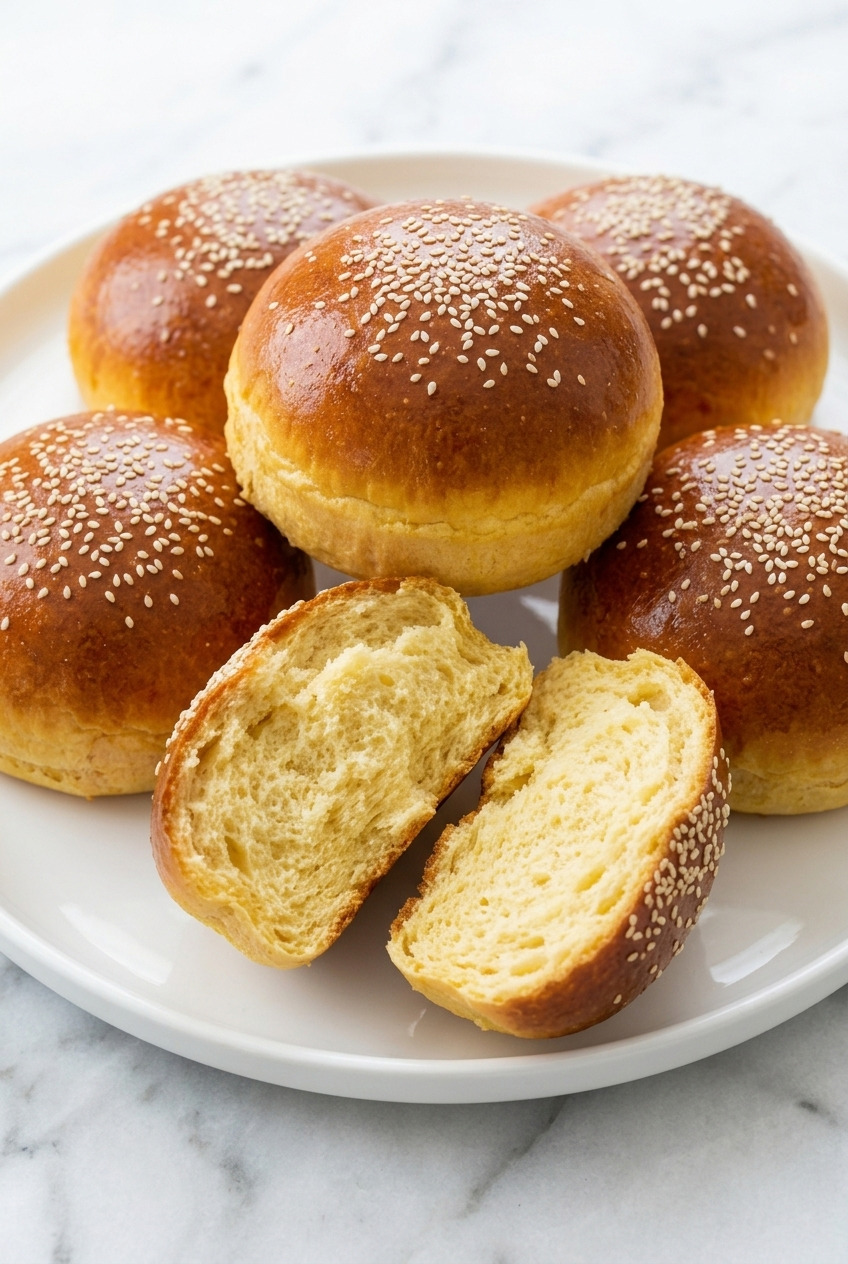
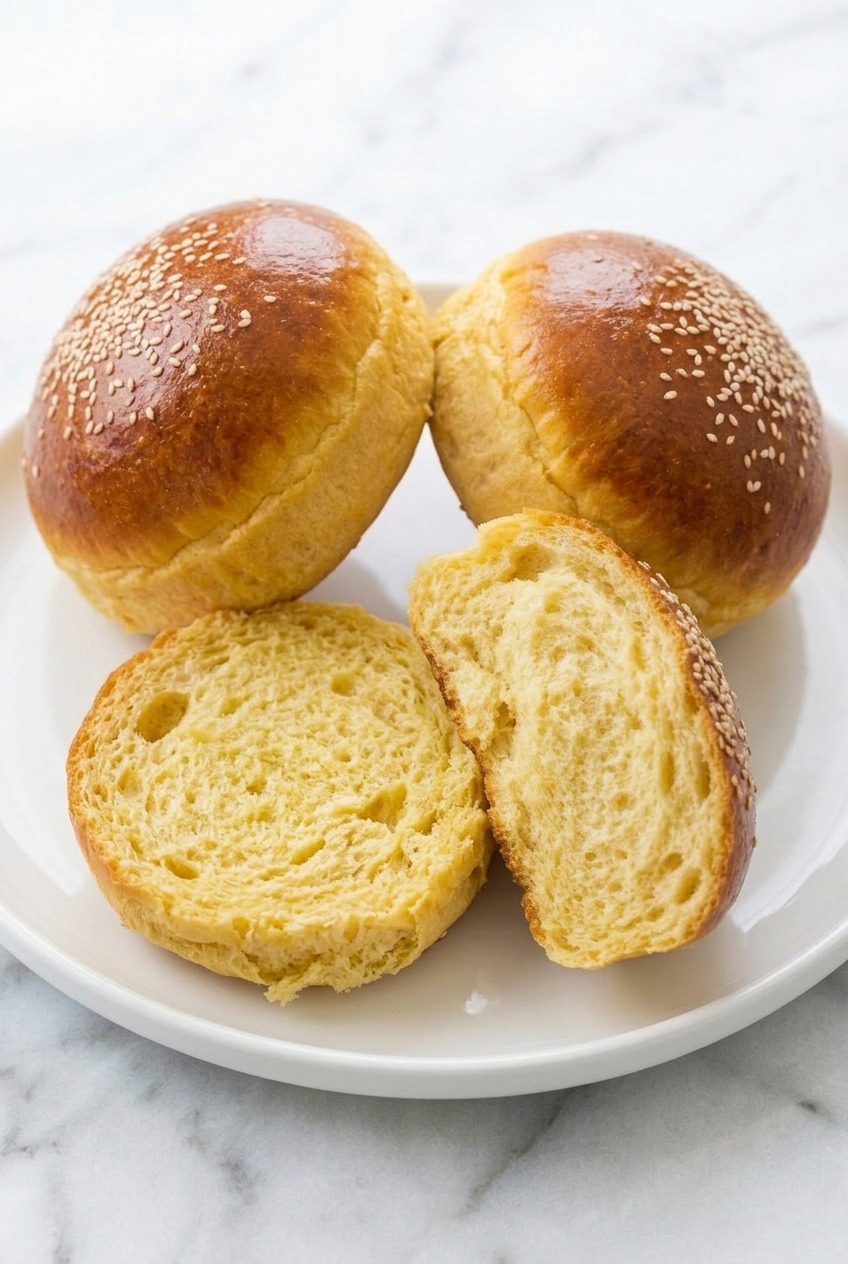
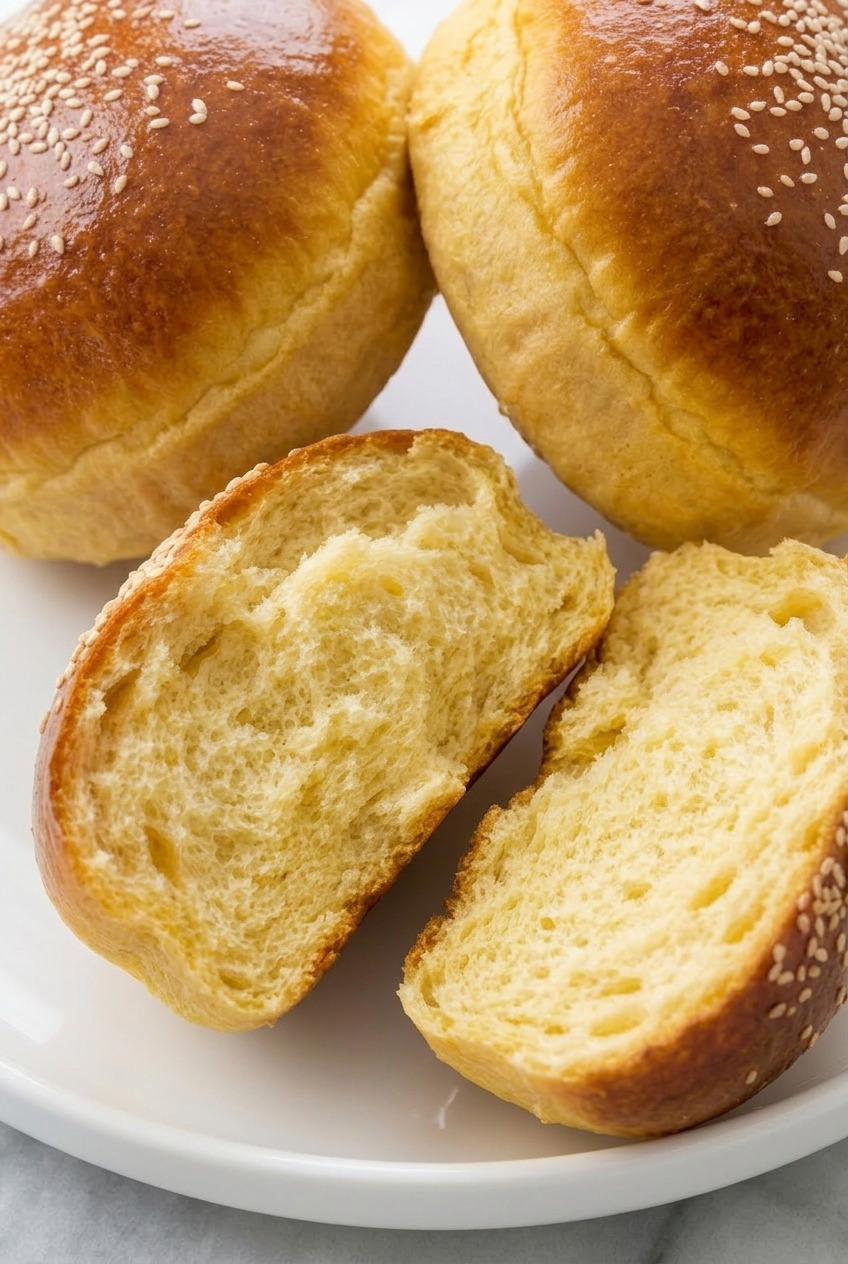
What comes out of the oven is a bun with a deep golden, shiny top and a crumb that is tight, even and pillowy.
Not flaky. Not layered. Pillowy.
Two things make the difference, and both of them are things the recipes I read online skip right past.
First: bake the sweet potato, never boil it.
A boiled sweet potato smuggles water into your dough that you did not measure and cannot see.
Second: hold back the last ½ cup of flour and add it only if the dough tells you to.
Sweet potatoes vary wildly in moisture, so a fixed flour number is a guess.
Fair warning, this dough is tacky and it is supposed to be.
Resist the urge to fix it with more flour, or you will bake bricks!
What These Buns Are, and What They Are Not
These are soft, enriched, pillowy buns with a fine even crumb. Butter and egg go into the dough, which is what makes them brioche style.
They are not flaky and they have no layers.
Nothing gets folded, nothing gets laminated, and if you pull one apart you should see a fine, close, uniform crumb rather than sheets.
Are they sweet? Barely.
There is 2 ½ tablespoons of brown sugar across twelve buns, so what you taste is a faint warm background, not dessert. The sweet potato reads mostly as colour and softness.
They are strong enough to hold a burger without going soggy, and soft enough that a kid will eat one plain.
Bake the Sweet Potato, Never Boil It
This is the single instruction that decides whether the recipe works. I am putting it near the top for that reason.
Boiling drives water into the flesh.
That water is invisible in the mash and it goes straight into your dough, and now your hydration is off by an amount you have no way to measure.
Roasting does the opposite. It drives water out and concentrates the flavour, so the mash you scoop out is thick and dense.
How I do it: prick one medium sweet potato, bake at 400°F for 50 to 60 minutes until it is collapsing and a knife goes in with no resistance, then split it and scoop the flesh out hot.
Mash it smooth and let it cool to just warm before it meets the yeast.
Hot mash kills yeast. Cold mash stiffens the butter. Warm is the target.
Pro tip: bake two while the oven is on and freeze the second batch of mash in a bag. Future you will be delighted.
Ingredients You Need
- Mashed baked sweet potato (¾ cup, about 200 g). One medium potato, roasted and cooled to warm. The whole point of the recipe.
- Bread flour (3 ⅓ cups, 500 g), plus up to ½ cup more. Bread flour, not all purpose. You need the extra protein because this dough is already softened by fat, egg and vegetable, and AP flour gives you a bun that squashes flat under a burger.
- Whole milk (¾ cup), warm. Around 105°F, which is barely warm on your wrist.
- Instant yeast (2 ¼ teaspoons). One packet. Active dry works too, just proof it in the warm milk for 10 minutes first.
- Brown sugar (2 ½ tablespoons). Feeds the yeast, deepens the colour, and keeps the bun on the savoury side of the line.
- Egg (1 large) plus 1 yolk. The extra yolk is a small thing that does a lot. Fat and lecithin, which means a softer crumb and a longer shelf life.
- Unsalted butter (6 tablespoons, 85 g), soft. Genuinely soft, the kind you can dent with a finger. Cold butter will not incorporate and you will chase it around the bowl.
- Table salt (1 ½ teaspoons). Do not cut it. Under salted enriched bread tastes like nothing.
- Egg wash (1 egg plus 1 tablespoon milk). This is where the shine comes from. Skip it and you get a dull, pale bun.
- Sesame seeds, optional. White or black. Purely a looks decision, and I go back and forth.
Why the Dough Is Sticky, and What to Do
Your dough will be tacky and you should let it be tacky. This is the part where people panic.
You have a wet vegetable, milk, an egg, a yolk and butter all in one bowl.
That is a lot of soft, and soft dough is exactly what produces a soft bun.
Here is the test I use instead of a number.
After 6 minutes of kneading, the dough should pull cleanly away from the sides of the bowl while still clinging to the bottom.
That is the target. Clean sides, sticky bottom.
If it is still smearing up the walls at that point, add the reserved flour 1 tablespoon at a time and give it a full minute between additions.
Too dry? Sound bad? It is worse than too wet, honestly.
A slightly wet dough gives you a soft bun with a slightly rustic shape. A dry dough gives you a dense one, and there is no fixing that after the fact.
How to Make Sweet Potato Brioche Buns
Step 1: Bake and Mash the Sweet Potato
Prick one medium sweet potato all over and bake at 400°F for 50 to 60 minutes.
Scoop the flesh, mash it completely smooth, and measure out ¾ cup.
Let it cool until it is warm rather than hot.
Step 2: Mix and Knead the Dough
In the mixer bowl, whisk the warm milk, yeast and brown sugar and let it sit 5 minutes until it looks foamy.
Add the sweet potato mash, the egg and the yolk, then 3 cups of the flour and the salt.
Mix on low with the dough hook until it comes together, then knead on medium low for 6 minutes.
Step 3: Work In the Butter
With the mixer running, add the soft butter one tablespoon at a time, waiting until each piece disappears before the next goes in.
The dough will look broken and greasy in the middle of this. Keep going.
Knead another 6 to 8 minutes until it is smooth, glossy and pulling off the sides of the bowl.
This is the moment to add the reserved flour if you need it.
Step 4: Bulk Prove
Scrape the dough into a lightly oiled bowl, cover, and let it rise 60 to 90 minutes until doubled.
The poke test beats the clock. Press a floured finger into the dough about half an inch. If the dent fills back slowly and only part way, it is ready.
Step 5: Shape and Second Prove
Turn the dough out and divide it into 12 equal pieces, about 85 g each if you own a scale.
Shape each into a taut ball, then flatten each one gently to about 3 inches across so it bakes as a bun and not a sphere.
Space them on two lined sheet pans and prove 40 to 45 minutes until puffy and touching at the edges.
Step 6: Egg Wash and Bake
Brush generously with the egg wash, all the way down the sides, and add sesame seeds if you want them.
Bake at 375°F for 18 to 20 minutes, until deeply golden and an internal temperature of 190°F.
Cool on a rack for at least 30 minutes before cutting, because the crumb is still setting.
Shaping for a Tight, Even Crumb
Shaping is where the crumb is decided, not the recipe. A loose ball spreads sideways and bakes into a flat, open, holey bun.
The move is called cup and drag.
- Cup your hand over the piece. Fingertips and the heel of your hand both touching the counter, dough underneath like a cave.
- Drag it toward you in a small circle. The friction against the bare counter pulls the outer skin tight.
- Do not flour the counter. This is the one place flour hurts you. The dough needs grip to build tension.
- Stop when the top goes smooth and taut. Usually four or five circles. Any more and you tear the skin you just built.
Flatten each taut ball with your palm before the second prove.
Round dough bakes into a ball, and a ball makes a terrible burger.
Storage, Freezing and Reviving
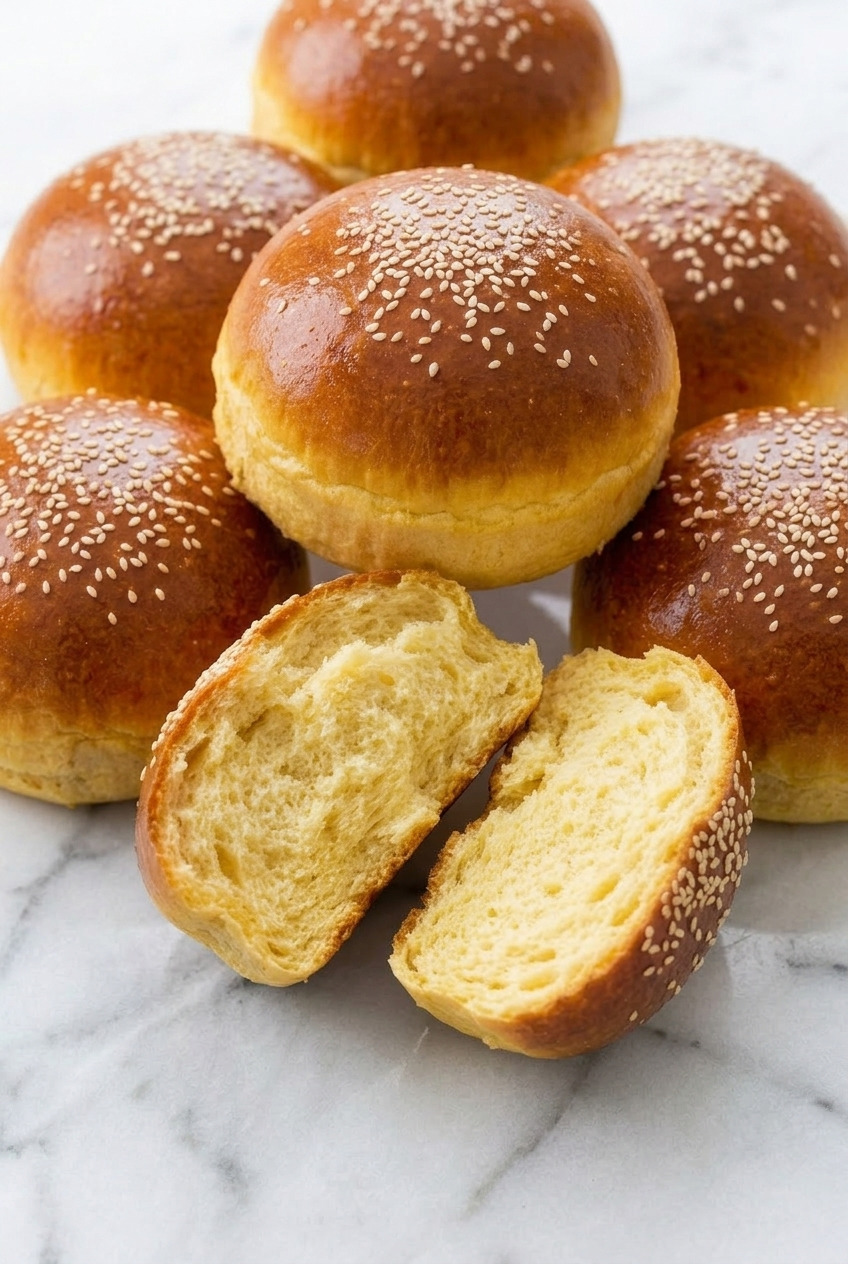
- Counter, 3 days. Fully cooled, in a bag or an airtight box. This is where the sweet potato earns its keep.
- Never the fridge. Refrigeration stales bread faster than the counter does. It is the worst place you can put these.
- Freezer, 3 months. Cool completely, bag whole and unsliced, and press the air out.
- Reviving from frozen. Thaw at room temperature, then 5 minutes in a 325°F oven. They come back genuinely close to fresh.
- Day old rescue. Split, butter the cut faces, and toast them in a dry skillet until the edges go brown and crisp.
What to Put on Them
They were built for burgers, but I use them for more than that. The faint sweetness plays well against salt and smoke.
- Burgers, obviously. The bun holds up to a juicy patty without disintegrating, which is the entire reason I started making them.
- Pulled pork. My favourite use. Sweet potato and vinegary pork are a genuinely great pairing!
- A fried egg and hot sauce. Fifteen minutes, and a better breakfast sandwich than anything I can buy.
- Split and toasted with butter. With soup. Do not overthink it.
- Roast turkey and cranberry. These are excellent dinner rolls in disguise, and they belong on a holiday table.
Frequently Asked Questions
Can I use canned sweet potato puree?
Yes, but drain it and check it first. Canned puree is usually wetter than roasted flesh, so measure your ¾ cup, then start with 3 cups of flour and expect to need most of the reserved ½ cup. Do not use canned sweet potatoes packed in syrup.
Why is my dough so sticky?
Because it is supposed to be, up to a point. The test is clean sides and a sticky bottom after 6 minutes of kneading. If it is still smearing up the walls of the bowl, add the reserved flour one tablespoon at a time, waiting a full minute between additions so the flour actually hydrates before you judge it.
Can I make these by hand without a stand mixer?
You can, and it takes about 15 minutes of kneading instead of 12. The butter stage is the hard part by hand. Use the slap and fold method on an unfloured counter, add the butter in small pieces, and accept that it will look like a disaster for a few minutes before it comes together.
Can I make the dough the night before?
Yes, and it actually improves the flavour. After kneading, cover the bowl and refrigerate it overnight instead of doing the bulk prove on the counter. In the morning, divide and shape the cold dough, then let the shaped buns prove 90 minutes or so, since they are starting from fridge temperature.
Do these taste sweet?
Only faintly. There is 2 ½ tablespoons of brown sugar spread across twelve buns, which is less than most supermarket hamburger buns contain. The sweet potato contributes colour and moisture far more than sugar. They read as a soft savoury bun with a warm background note.
Can I turn the same dough into dinner rolls?
Absolutely. Divide into 16 smaller pieces instead of 12, shape them into taut balls, and do not flatten them. Prove them close together in a 9x13 pan so they rise into each other, and bake at 375F for 16 to 18 minutes. Brush the tops with melted butter as they come out.
How do I freeze and revive them?
Cool completely, then freeze whole and unsliced in a bag with the air pressed out, for up to 3 months. Slicing before freezing dries the cut faces. To revive, thaw at room temperature and warm for 5 minutes in a 325F oven, which softens the crumb and refreshes the crust.
Bake the potato, keep the dough tacky, and shape the balls tight.
That is the whole recipe, and the reward is a bun that is still soft on Wednesday.
Recipe
Sweet Potato Brioche Buns
Ingredients
For the Dough
- ¾ cup mashed baked sweet potato about 200 g, from 1 medium potato, cooled to warm
- ¾ cup whole milk warm, about 105F
- 2 ¼ teaspoons instant yeast 1 packet
- 2 ½ tablespoons brown sugar
- 3 ⅓ cups bread flour 500 g, plus up to ½ cup more added by feel
- 1 ½ teaspoons table salt
- 1 large egg plus 1 extra yolk
- 6 tablespoons unsalted butter 85 g, genuinely soft, cut in pieces
For the Wash and Topping
- 1 large egg beaten, for the wash
- 1 tablespoon whole milk for the wash
- 2 teaspoons sesame seeds optional
Instructions
Bake the Sweet Potato
- Prick 1 medium sweet potato all over and bake at 400F for 50 to 60 minutes, until it is collapsing and a knife meets no resistance. Never boil it, because boiled flesh carries water you cannot measure into the dough.
- Split it, scoop out the flesh, mash it completely smooth and measure ¾ cup. Let it cool until it is warm rather than hot.
Make the Dough
- Whisk the warm milk, instant yeast and brown sugar in the bowl of a stand mixer and let it stand 5 minutes until foamy.
- Add the sweet potato mash, the whole egg and the extra yolk, then 3 cups of the bread flour and the salt. Mix on low with the dough hook until it comes together, then knead 6 minutes on medium low.
- With the mixer running, add the soft butter one tablespoon at a time, letting each piece disappear before adding the next. The dough will look broken for a few minutes. Keep going.
- Knead another 6 to 8 minutes until smooth and glossy. The dough should pull cleanly from the sides of the bowl while still clinging to the bottom. If it is still smearing up the walls, add the reserved flour 1 tablespoon at a time, waiting a full minute between additions.
Prove, Shape and Bake
- Scrape the dough into a lightly oiled bowl, cover, and let it rise 60 to 90 minutes until doubled. A floured finger pressed half an inch in should leave a dent that fills back slowly and only part way.
- Divide into 12 equal pieces, about 85 g each. Cup your hand over each piece and drag it in small circles on an unfloured counter until the surface is smooth and taut, then flatten each ball to about 3 inches across.
- Space the buns on two lined sheet pans and prove 40 to 45 minutes, until puffy and just touching at the edges.
- Brush all over with the egg wash beaten with the milk, right down the sides, and add sesame seeds if using. Bake at 375F for 18 to 20 minutes, until deeply golden and 190F inside.
- Cool on a rack at least 30 minutes before slicing, so the crumb finishes setting.
Notes
- Bake, never boil: roasting drives water out and concentrates the sweet potato. Boiling adds water you cannot measure and slackens the dough.
- Flour by feel: hold back the last ½ cup. After 6 minutes of kneading the dough should clear the sides of the bowl but still stick to the bottom.
- Shape on a bare counter: flour kills the friction that builds surface tension, and slack balls bake flat and holey.
- Flatten before the second prove: round dough bakes into a sphere, which makes a poor burger bun.
- Overnight option: refrigerate the kneaded dough overnight instead of the bulk prove, then shape cold and prove 90 minutes.
- Storage: 3 days on the counter, 3 months in the freezer, never the fridge. Revive frozen buns for 5 minutes at 325F.