I ruined eleven in a row before one held together.
This was in my friend Ravi's kitchen, at his mother's counter, on a Sunday afternoon in the middle of winter.
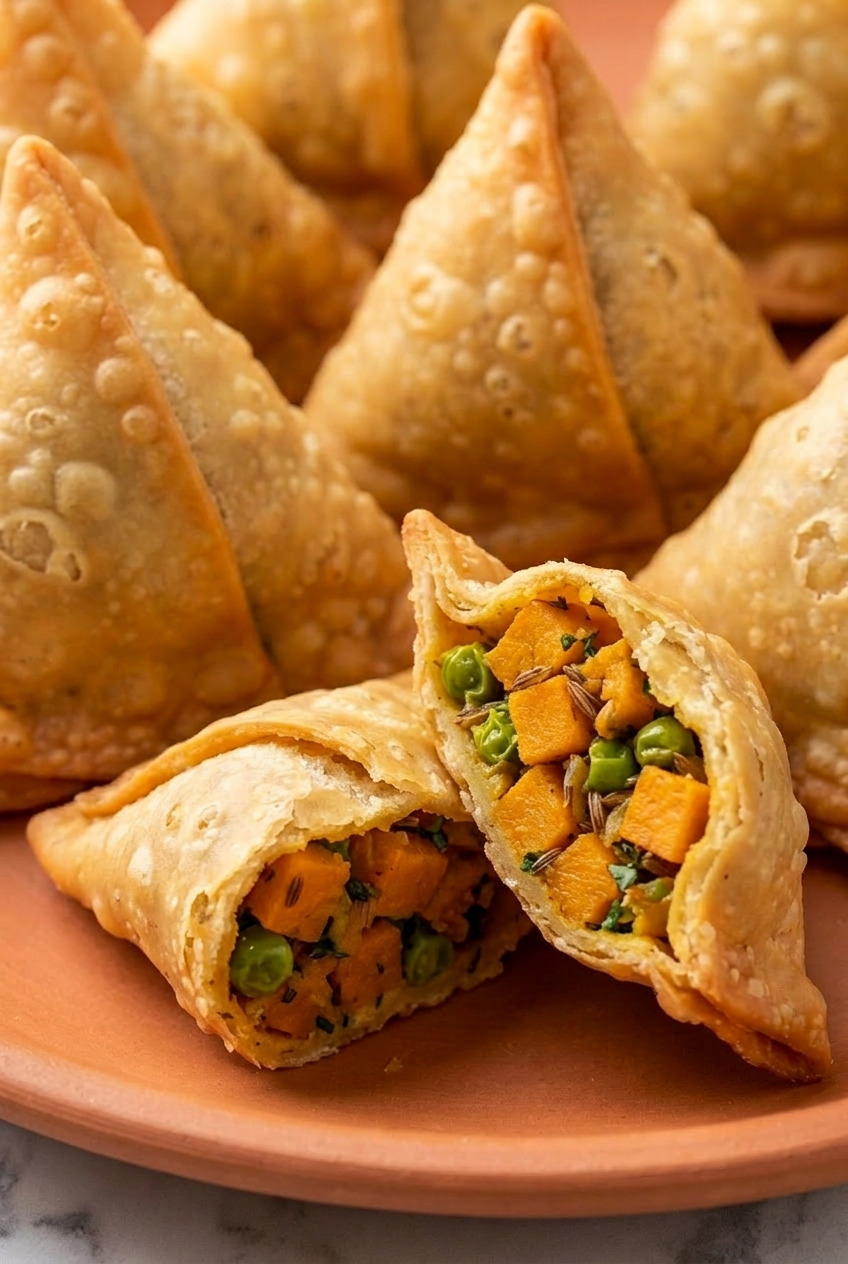
She had been folding samosas for about forty years and she made it look like nothing at all.
A quick roll, a cut, a twist of the wrist, and there was a perfect little cone sitting in her palm.
Mine kept splitting at the seam and leaking filling into the oil.
What she did instead was slow the whole thing down to six separate moves and make me do each one twenty times.
By the end of the afternoon I could fold a cone that held.
That is the part almost every recipe online skips right past, and it is the part that actually decides whether you end up with samosas or with a pan of hot oil and regret.
The sweet potato filling is mine, not hers. The classic is aloo, made with regular potatoes, and I would never claim otherwise.
But sweet potato takes the same cumin, coriander and amchoor beautifully, and it brings a little sweetness that plays against the heat.
Make the dough stiff, fold it properly, and fry it twice.
Do that and you get a shell that shatters when you bite it. I promise it is worth the afternoon.
Why These Samosas Work
- Real samosa pastry, not puff pastry. A stiff dough with fat rubbed into the flour gives you a thin, hard, blistered shell that stays crisp for hours.
- Diced filling, not paste. Small cubes of sweet potato with a third of it crushed, so you get texture instead of a smooth mush.
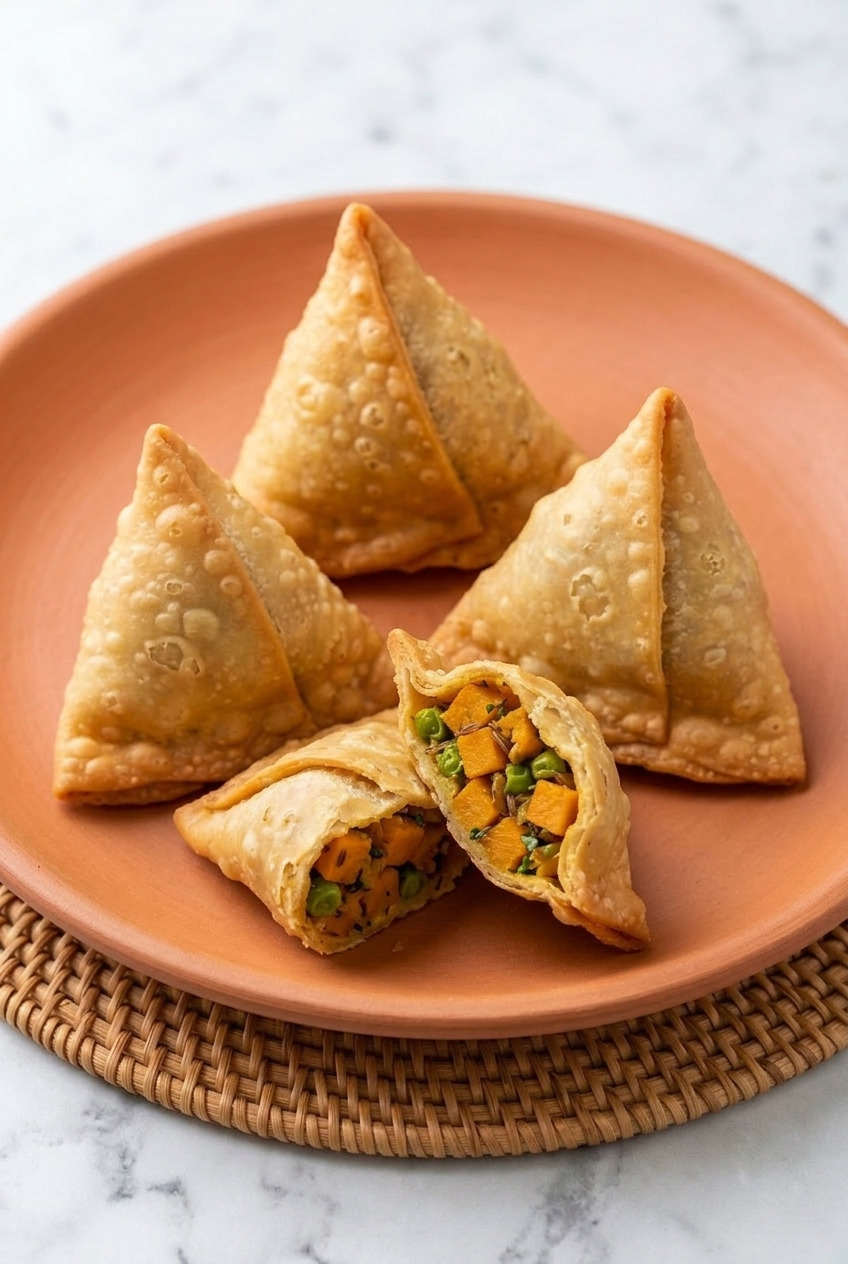
- The two stage fry. Low first, hot second. This is what produces the bubbled, crackled surface you see at a good samosa shop.
- The fold, taught properly. Six moves, each one explained, with the mistake that goes with it.
- Freezer friendly. Fold a full batch, freeze them raw, fry them straight from frozen whenever you want.
A Note on What This Is
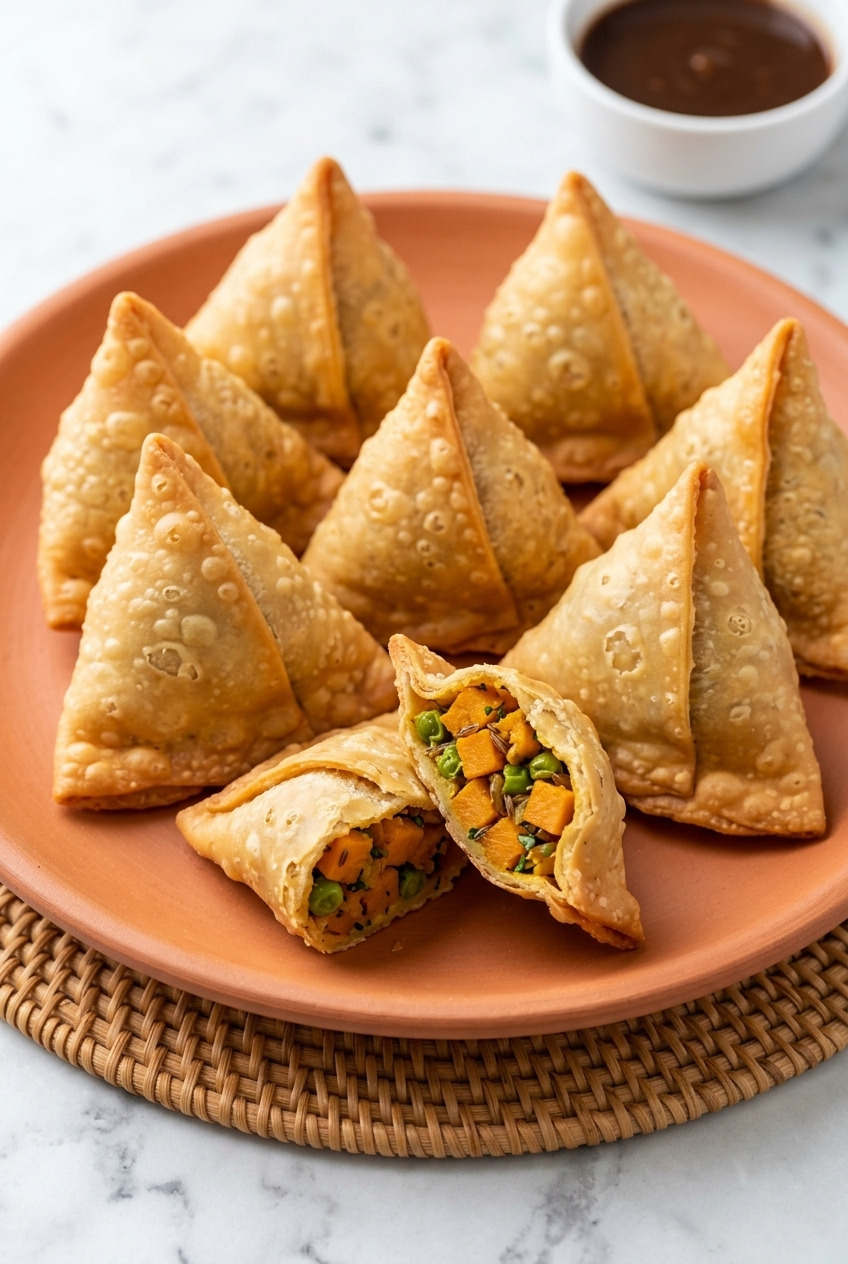
The samosa is an Indian snack with a very long history, and the classic version is aloo samosa, made with spiced potato and peas. It has been made across the subcontinent for centuries and it is sold on nearly every street in North India.
What I am giving you here is a sweet potato variation on that classic.
The spicing is traditional. The technique is traditional. The sweet potato is my own swap, and it is not what you would be served in Delhi.
I mention it because I think it matters to be clear about which parts are borrowed and which parts are mine.
If you want the original, use waxy white potatoes and everything else here stays exactly the same.
Ingredients You'll Need
For the Pastry
- All-purpose flour (2 cups). Plain flour is correct here. No bread flour, no self rising.
- Ajwain, carom seeds (1 teaspoon). The traditional seasoning in samosa dough. It tastes a little like thyme with a sharper edge, and it is worth seeking out at any Indian grocer.
- Salt (1 teaspoon).
- Ghee or neutral oil (5 tablespoons). This is the moyan, the fat rubbed into the flour, and it is the single reason a samosa shell turns out short and crisp rather than tough. Do not cut it back.
- Cold water (about ½ cup). The least the dough will accept. Stiff dough, always.
For the Filling
- Sweet potatoes (1 ¼ pounds, peeled and cut in ⅓ inch dice). Diced, not mashed. The cubes hold their shape and keep the filling from going pasty.
- Neutral oil (3 tablespoons).
- Cumin seeds (1 teaspoon). Whole, bloomed in hot oil first.
- Onion (1 small, finely chopped) and fresh ginger (1 tablespoon, grated).
- Green chilies (2, minced). Serrano or Thai. Adjust to your own heat tolerance.
- Frozen peas (¾ cup). Straight from the freezer, no thawing.
- Ground coriander (1 teaspoon), ground cumin (½ teaspoon), Kashmiri chili powder (½ teaspoon), turmeric (¼ teaspoon).
- Amchoor, dried mango powder (1 teaspoon). The sour note. This is the flavor people cannot name when they eat a good samosa, and almost every recipe leaves it out.
- Garam masala (½ teaspoon). Added at the very end, off the heat, so it stays fragrant.
- Salt (1 ½ teaspoons) and chopped cilantro (⅓ cup).
To Seal and Fry
- Flour paste. 2 tablespoons flour whisked with 2 tablespoons water into a smooth glue.
- Neutral oil for deep frying. Enough for about 2 inches in a deep pan.
Make the Dough First
Rub the ghee into the flour with your fingertips until the mixture looks like damp sand and holds its shape when you squeeze a fistful. Add the ajwain and salt as you go.
Take your time on this. Two full minutes of rubbing.
Then add cold water a tablespoon at a time, gathering the dough with your hands, and stop the moment it comes together.
It should feel stiff, closer to a firm modeling clay than to a bread dough.
Too soft? You will get a chewy, bubbly, greasy shell.
Knead it just enough to smooth it out, maybe a minute, then wrap it and rest it for 30 minutes.
Pro tip: the rest is not optional. It relaxes the dough so it rolls thin without springing back.
Make the Filling
Heat the oil over medium heat and drop in the cumin seeds. They should sizzle and smell nutty within about ten seconds.
Add the onion and cook it 5 minutes, until soft and just turning gold.
Stir in the ginger and green chilies for a minute.
Add the diced sweet potato, the coriander, ground cumin, Kashmiri chili, turmeric and salt, along with ¼ cup of water.
Cover and cook 10 to 12 minutes, stirring now and then, until the cubes are tender but still holding their edges.
Add the peas and cook two minutes more.
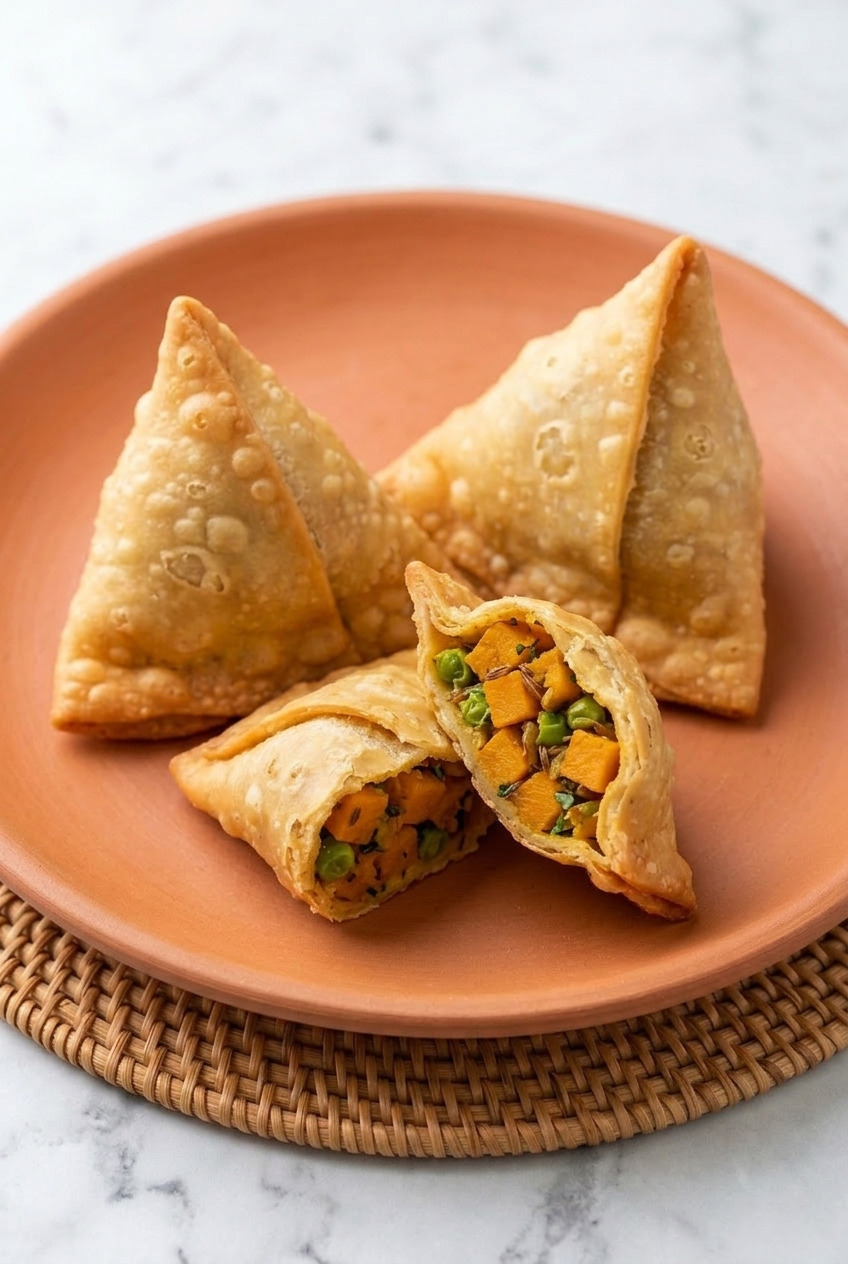
Now crush about a third of the mixture against the side of the pan with the back of a spoon.
That crushed third binds everything together while the rest stays in recognizable pieces.
Off the heat, stir in the amchoor, garam masala and cilantro.
Fair warning: the filling must be completely cool before it goes near the dough. Warm filling softens the pastry and the seam will not hold.
How to Fold a Samosa
This is the heart of the whole recipe, so read it once through before you start. Divide the rested dough into 8 balls. Each ball makes two samosas.
Move 1: Roll and Cut
Roll one ball into a thin oval about 7 inches long and 5 inches wide. Thin, roughly the thickness of a coin.
Cut it straight across the middle into two half circles.
Common mistake: rolling it too thick. A thick round gives you a bready shell that never crisps through.
Move 2: Form the Cone
Take one half circle and lay it with the straight edge toward you.
Brush the straight edge with flour paste, right across its full length.
Fold one half of the straight edge over to meet the other, overlapping by about ¼ inch, and you have a cone.
Common mistake: lining the edges up exactly instead of overlapping them. Without the overlap there is nothing for the paste to grip.
Move 3: Seal the Seam
Press the overlapped seam firmly between your thumb and finger, top to bottom.
Run your finger down it a second time.
Hold the cone up and look at it. There should be no gap and no light showing through.
Common mistake: a lazy seam. This is where the leaks happen, and a leaking samosa fills with oil.
Move 4: Fill It
Cup the cone in one hand and spoon in about 2 heaping tablespoons of cool filling.
Press it down gently so there are no air pockets, but leave about ½ inch of clear pastry at the open top.
Common mistake: overfilling. It feels stingy at first, and then the top will not close.
Move 5: Pinch the Top Closed
Brush the inside of the open edge with flour paste, then press the front and back together into a flat seal.
Make a small pleat in the middle of that top seal by folding a little tuck of pastry over on itself, then press again.
That pleat is what gives a samosa its shape, and it doubles the strength of the weakest seam.
Move 6: Rest Them Seam Up
Set each finished samosa on a tray, resting on its flat base, and let the seams dry for 10 minutes before frying.
Cover them with a damp towel if you are working slowly, so the pastry does not crack.
How to Fry Them
Heat 2 inches of oil to 275°F, which is much lower than you think.
Slide in 4 or 5 samosas and fry them for 8 to 10 minutes, turning once.
They will barely color. That is the point.
This slow stage dries the shell out from the inside and lets tiny bubbles form across the surface.
Lift them out and rest them on a rack for at least 5 minutes.
Then bring the oil up to 360°F and return them in batches for 2 to 3 minutes, until they are deep golden and blistered all over.
Worth the extra step? Every single time.
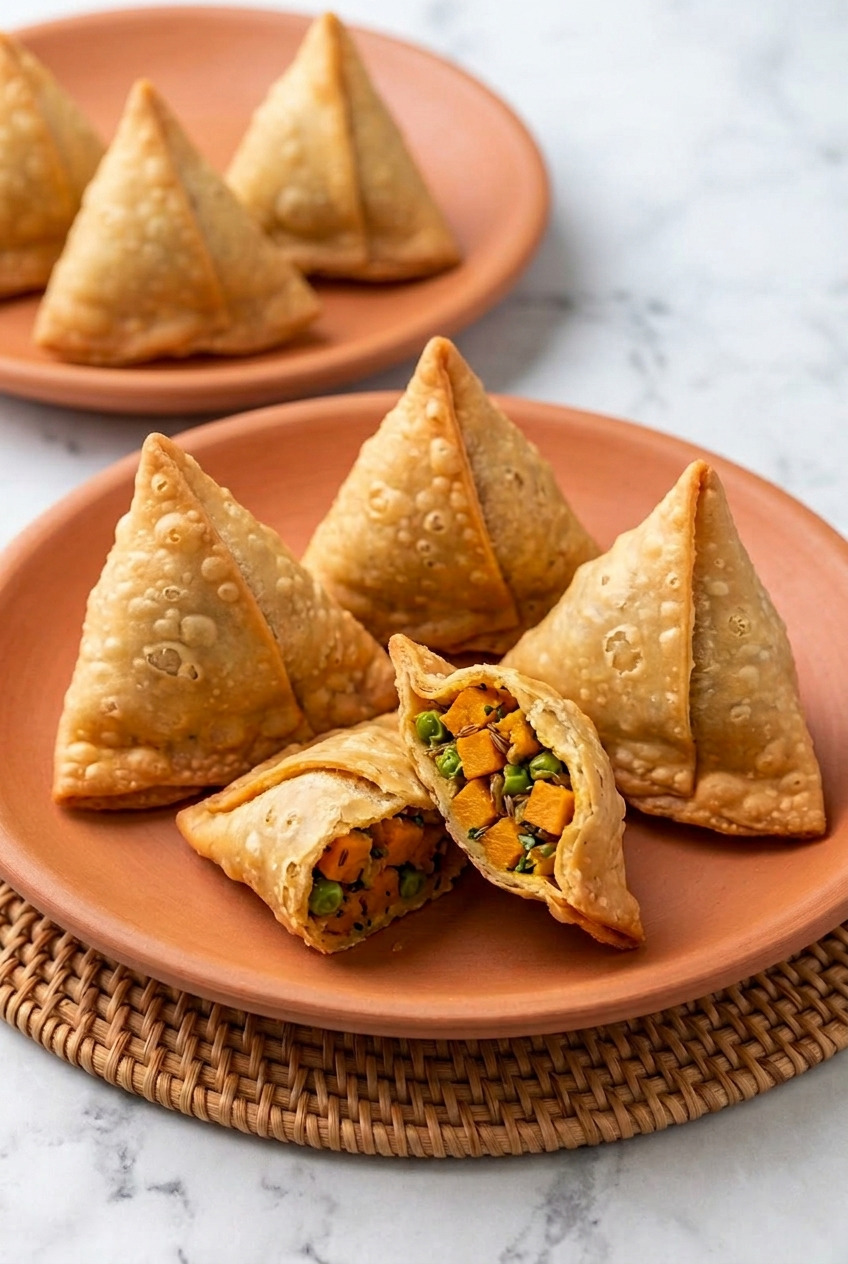
A one stage fry gives you a smooth, pale, slightly oily shell. Two stages give you the crackled, bubbled surface that makes the whole thing.
Baking and Air Fryer Instructions
Both work, and both give you a different snack. I want to be honest about that rather than pretend otherwise.
- Oven. Brush the folded samosas all over with oil and bake at 400°F for 25 to 30 minutes, turning halfway. The shell comes out firm and short, more like a pastry than a samosa.
- Air fryer. Brush with oil and cook at 375°F for 14 to 16 minutes, turning once. Closest of the two to the real thing.
- What you lose. The blistering. Neither method bubbles the surface, because that comes from oil surrounding the whole shell at once.
Common Mistakes
- Soft dough. The most damaging one. A soft, hydrated dough puffs and bubbles like a poori and goes chewy.
- Warm filling. Softens the pastry from the inside and pops the seams open in the oil.
- An unsealed seam. Check every cone against the light before you fill it.
- Oil too hot at the start. The outside sets before the inside dries, and the shell stays soft under a browned surface.
- Crowding the pan. Five at a time, no more. Too many drops the oil temperature hard.
What to Serve With Them
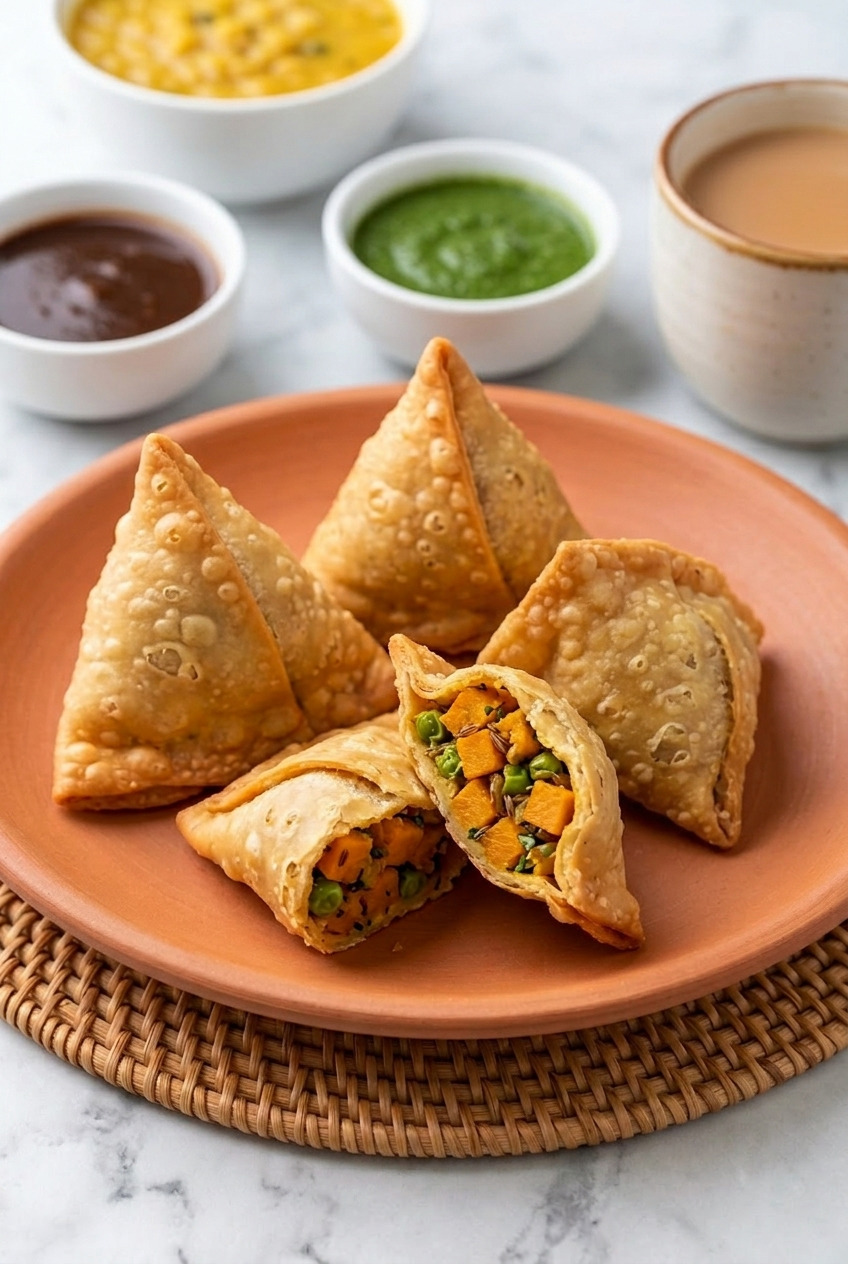
Tamarind chutney is the classic partner, sweet and sour and dark. Mint cilantro chutney is the other one, bright and sharp and green.
Having both on the table is the right move.
A cup of masala chai alongside is how they are eaten in the afternoon across North India.
For a bigger spread, put them next to a dal and some plain rice and you have dinner.
Storing and Freezing
- Freeze them raw. This is the best way by a wide margin. Freeze the folded samosas on a tray in a single layer until solid, then bag them for up to 3 months.
- Fry from frozen. No thawing. Straight into the 275°F oil, and add about 3 minutes to the first stage.
- Cooked leftovers. They keep 2 days in the fridge and reheat crisp in a 375°F oven for 8 minutes.
- Never the microwave. It turns a crisp shell soft and leathery in about twenty seconds.
- The filling alone. Keeps 3 days covered in the fridge, so you can split the work across two days.
Frequently Asked Questions
What is samosa filling made of?
Classically, spiced potato and green peas with cumin, coriander, ginger, chili and amchoor. This version swaps the potato for diced sweet potato and keeps the spicing exactly as it should be.
Why is my samosa pastry soft instead of crisp?
Two likely causes. The dough was too soft to begin with, or you skipped the low temperature first fry. A stiff dough plus 8 to 10 minutes at 275°F before the hot finish is what makes a shell shatter.
Can I bake or air fry these instead of frying?
You can. Bake at 400°F for 25 to 30 minutes or air fry at 375°F for 14 to 16 minutes, brushing with oil either way. The result is good, but the shell will not blister.
Can I use store bought samosa sheets, spring roll wrappers or puff pastry?
Samosa patti sheets work well and save real time. Spring roll wrappers give a thinner, more brittle shell. Puff pastry is the one to avoid, because it rises into flaky layers and a samosa is meant to be thin and hard, not layered.
Should the sweet potato be mashed or diced?
Diced, in ⅓ inch cubes, with about a third of it crushed at the end. A fully mashed filling turns pasty inside the hot shell.
Can I freeze samosas before frying?
Yes, and it is the best reason to make a full batch. Freeze them folded and raw on a tray, then bag them for 3 months and fry straight from frozen.
What do you serve with sweet potato samosas?
Tamarind chutney and mint cilantro chutney, ideally both, with hot masala chai. They also sit happily next to a simple dal and rice as part of a larger meal.
Recipe
Sweet Potato Samosas
Ingredients
For the Pastry
- 2 cups all-purpose flour
- 1 teaspoon ajwain carom seeds
- 1 teaspoon salt
- 5 tablespoons ghee or neutral oil
- ½ cup cold water approximately, added a spoonful at a time
For the Filling
- 1 ¼ pounds sweet potatoes peeled and cut in ⅓ inch dice
- 3 tablespoons neutral oil
- 1 teaspoon cumin seeds
- 1 small onion finely chopped
- 1 tablespoon fresh ginger grated
- 2 green chilies minced
- ¾ cup frozen peas
- 1 teaspoon ground coriander
- ½ teaspoon ground cumin
- ½ teaspoon Kashmiri chili powder
- ¼ teaspoon turmeric
- 1 teaspoon amchoor dried mango powder
- ½ teaspoon garam masala
- 1 ½ teaspoons salt
- ⅓ cup cilantro chopped
To Seal and Fry
- 2 tablespoons all-purpose flour whisked with 2 tablespoons water into a paste
- 6 cups neutral oil for deep frying, about 2 inches deep
Instructions
Make the Dough
- Rub the ghee into the flour with your fingertips for a full 2 minutes, along with the ajwain and salt, until the mixture looks like damp sand and holds its shape when squeezed.
- Add cold water a tablespoon at a time and gather the dough together, stopping as soon as it comes together. It should feel stiff, closer to firm modeling clay than to bread dough. Knead it smooth for a minute, wrap it, and rest it 30 minutes.
Make the Filling
- Heat the oil over medium heat and add the cumin seeds. When they sizzle, add the onion and cook 5 minutes until soft and just turning gold. Stir in the ginger and green chilies for 1 minute.
- Add the diced sweet potato, coriander, ground cumin, Kashmiri chili, turmeric, salt and ¼ cup water. Cover and cook 10 to 12 minutes, until the cubes are tender but still holding their edges. Add the peas and cook 2 minutes more.
- Crush about a third of the mixture against the side of the pan with the back of a spoon. Off the heat, stir in the amchoor, garam masala and cilantro. Cool the filling completely before folding.
Fold the Samosas
- Divide the dough into 8 balls. Roll one into a thin oval about 7 inches by 5 inches, roughly the thickness of a coin, and cut it across the middle into two half circles.
- Lay a half circle with the straight edge toward you and brush that edge with flour paste. Fold one half of the straight edge over the other, overlapping by about ¼ inch, to form a cone. Press the seam firmly top to bottom and check that no light shows through.
- Spoon about 2 heaping tablespoons of cool filling into the cone, pressing out air pockets and leaving ½ inch of clear pastry at the top.
- Brush the inside of the open edge with flour paste, press the front and back together into a flat seal, fold a small pleat into the middle of that seal, and press again. Rest the finished samosas on a tray for 10 minutes.
Fry in Two Stages
- Heat 2 inches of oil to 275 degrees F. Fry 4 or 5 samosas at a time for 8 to 10 minutes, turning once. They should barely color. Rest them on a rack for at least 5 minutes.
- Raise the oil to 360 degrees F and return the samosas in batches for 2 to 3 minutes, until deep golden and blistered all over. Drain on a rack and serve hot with tamarind and mint cilantro chutneys.
Notes
- Stiff dough: add the least water the flour will take. A soft dough puffs and bubbles like a poori and goes chewy instead of crisp.
- Rub the fat in properly: two full minutes. The fat rubbed into the flour, the moyan, is what makes the shell short and crisp.
- Cool the filling completely: warm filling softens the pastry and the seams open in the oil.
- Two stage fry: 275 degrees F to dry and blister the shell, then 360 degrees F to color it. A single hot fry gives a smooth, soft, oily shell.
- Freeze raw: folded and unfried, on a tray then bagged, for up to 3 months. Fry straight from frozen with 3 extra minutes in the first stage.
- Not puff pastry: it rises into flaky layers, and a samosa shell should be thin and hard.